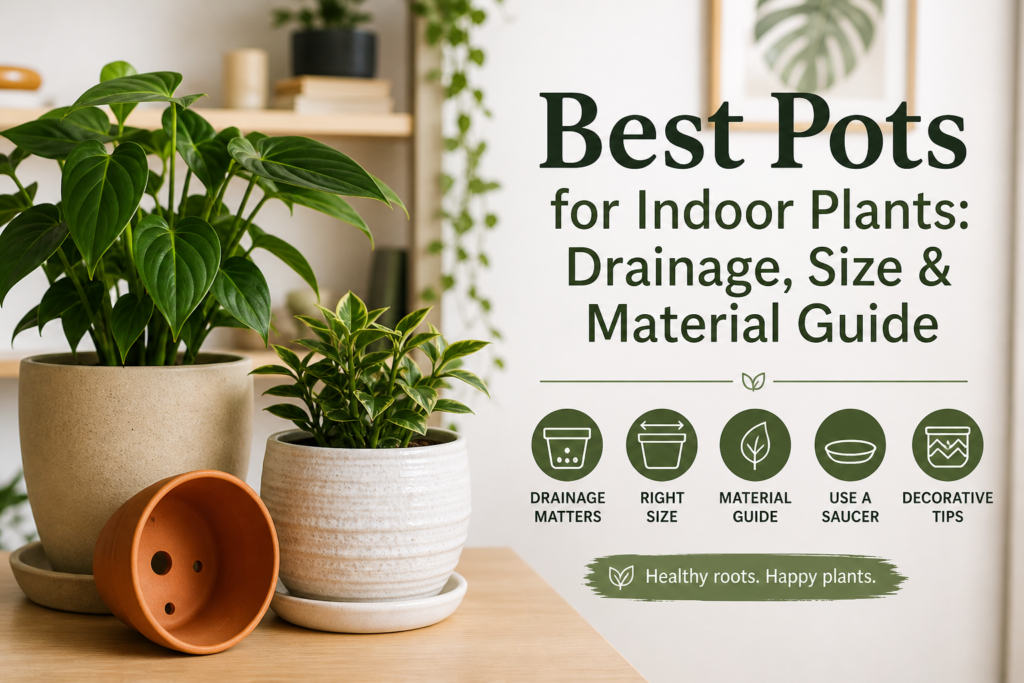
Most indoor plant problems don’t start with the plant.
They start with the pot.
A beautiful pot can look perfect on a shelf, but if it has no drainage, the roots can sit in water and slowly rot.
Choosing the right pot helps your plant breathe, drain properly, and grow healthier over time.
Here’s how to choose the best pots for indoor plants.
Some of the links below may be affiliate links. This means I may earn a small commission if you buy through them, at no extra cost to you.
Quick Decision Table
The best indoor plant pot depends on the plant, the room, and how you want the setup to look.
| If you want… | Choose… |
|---|---|
| A clean modern look | Ceramic pot |
| A warm natural look | Terracotta pot or woven basket cover |
| A lightweight option | Plastic nursery pot inside a decorative cachepot |
| A plant for a shelf | Small ceramic or plastic pot |
| A large floor plant | Heavy ceramic pot, fiberglass planter, or basket cover |
| Better airflow for soil | Terracotta pot |
| A decorative outer look | Cachepot with a removable inner nursery pot |
| Easy watering control | Pot with drainage hole and saucer |
A beautiful pot should not only match your decor. It should also make sense for the plant’s size, roots, watering needs, and placement.
1. Always Choose a Pot with Drainage Holes
Drainage is the most important thing to look for.
Without drainage holes, extra water stays trapped at the bottom of the pot.
That can lead to:
- root rot
- yellow leaves
- bad soil smell
- weak growth
If you are a beginner, always choose pots with drainage holes.
Why the Pot Matters More Than People Think
A plant pot is not just decoration.
The right pot can make a plant easier to care for, easier to move, and easier to style. The wrong pot can make watering more confusing, make the plant look unbalanced, or make the room feel cluttered.
A good indoor plant pot should help with:
- stability
- drainage
- root space
- room style
- surface protection
- easy watering
- plant size balance
- long-term display
The goal is to choose a pot that works for both the plant and the room. A pot can look beautiful and still be a poor match if it is too large, too small, too heavy, or has no drainage plan.
Indoor Plant Pot with Drainage
A simple pot with drainage holes helps prevent root rot and keeps indoor plants healthier.
Check on Amazon
2. Pick the Right Pot Size
Bigger is not always better.
If the pot is too large, the soil holds too much water. This can keep roots wet for too long.
A good rule:
Choose a pot only 1–2 inches wider than the current root ball.
This gives the roots room to grow without drowning the plant in extra soil.
How to Choose the Right Pot Size
Pot size matters because indoor plants usually do not like being placed in a pot that is much too large.
A good rule is to move up only slightly when repotting. In many cases, choosing a pot about 1–2 inches wider than the current pot is enough.
| Plant situation | Pot size choice |
|---|---|
| Plant is slightly root-bound | Move up one small pot size |
| Plant is very small | Keep it in a compact pot |
| Plant is large and top-heavy | Use a heavier, stable pot |
| Plant dries out too fast | Slightly larger pot may help |
| Soil stays wet too long | Pot may be too large or drainage may be poor |
| Plant is mostly for decor | Use a cachepot around the nursery pot |
A pot that is too large can hold more moisture than the plant can use. A pot that is too small can make the plant unstable or dry out too quickly.
3. Ceramic vs Plastic Pots
Both ceramic and plastic pots can work well.
Ceramic pots look more premium and stylish, but they can be heavier.
Plastic pots are lighter, cheaper, and easier to move.
For beginners, the most important thing is not the material.
It’s drainage.
4. Use a Saucer to Protect Your Furniture
If your pot has drainage holes, water can leak out.
That’s good for the plant, but bad for your furniture.
A saucer catches extra water and protects shelves, floors, and tables.
Just remember to empty the saucer after watering.
Plant Saucer / Drainage Tray
A saucer protects your furniture while still allowing your pot to drain properly.
Check on Amazon
5. Avoid Decorative Pots Without Drainage
Many decorative pots look beautiful but don’t have holes.
That doesn’t mean you can’t use them.
Use the decorative pot as a cover pot.
Keep the plant inside a plastic nursery pot with drainage, then place that inside the decorative pot.
This gives you the best of both worlds:
- beautiful look
- proper drainage
- healthier roots
Drainage vs Cachepot: What Is the Difference?
Many indoor plant problems start with confusion about drainage.
| Pot type | What it means | Best use |
|---|---|---|
| Pot with drainage hole | Water can escape through the bottom | Best for most plants |
| Cachepot | Decorative outer pot with no drainage hole | Best when used with an inner nursery pot |
| Self-watering pot | Holds water in a reservoir | Useful for some plants, but not all |
| Decorative pot only | Looks nice but may trap water | Needs careful use and an inner pot |
The safest setup for beginners is usually:
- plant stays in a nursery pot with drainage
- nursery pot sits inside a decorative cachepot
- excess water is removed after watering
This gives you the look of a decorative pot without trapping water around the roots.
Best Pot Materials Compared
Different pot materials create different looks and care habits.
| Pot material | Best for | Watch out for |
|---|---|---|
| Ceramic | Stylish indoor displays, shelves, side tables | Can be heavy and may need drainage planning |
| Terracotta | Classic plant look, breathable soil, warm decor | Dries faster and can stain surfaces |
| Plastic | Lightweight, practical, easy to move | Can look plain unless placed inside a cachepot |
| Fiberglass | Large floor plants, modern rooms | Usually more expensive |
| Metal | Decorative outer covers | Can heat up or trap moisture if used incorrectly |
| Woven basket | Natural decor, floor plants, cozy rooms | Needs an inner pot and saucer to protect the basket |
| Concrete | Modern statement plants | Heavy and harder to move |
For most indoor plants, a simple plastic nursery pot inside a decorative ceramic pot, basket, or cachepot is one of the easiest setups.
Decorative Indoor Plant Pot
A decorative planter can make your plant look more stylish while still working with a drainage pot inside.
Check on Amazon
Common Pot Mistakes That Make Plant Care Harder
The wrong pot can make even simple plant care feel confusing.
| Mistake | Why it causes problems |
|---|---|
| Choosing a pot with no drainage plan | Water can collect at the bottom |
| Using a pot that is too large | Soil may stay wet too long |
| Choosing a tiny pot for a heavy plant | The plant may tip over |
| Using a decorative pot without a saucer | Furniture and floors can get damaged |
| Picking a pot only for color | It may not match the plant’s needs |
| Forgetting the weight | Large pots can become hard to move |
| Using baskets without inner protection | Water can damage the basket and floor |
A good pot should look nice, but it should also make daily care easier.
Best For / Avoid If
A pot style can be beautiful, but it may not fit every plant or home.
| Pot style | Best for | Avoid if |
|---|---|---|
| Ceramic pot | Styled rooms, shelves, flowers, statement plants | You need something very lightweight |
| Terracotta pot | Plants that prefer faster drying soil | Your home is very dry or you forget watering often |
| Plastic pot | Practical care and easy moving | You want a finished decor look without a cachepot |
| Basket cover | Cozy floor plants and natural decor | You do not have an inner pot or saucer |
| Self-watering pot | Some moisture-loving plants | You grow plants that hate staying too wet |
| Concrete pot | Modern heavy statement displays | You move plants often |
Choose pots based on plant needs first, then decor style second. The best pot is the one that helps the plant fit your home and routine.
Final Thoughts
The best pot for an indoor plant is not always the prettiest one on the shelf.
A good pot should fit the plant’s size, support proper drainage, protect your furniture, and match the way you actually care for your plants. Ceramic pots, terracotta pots, plastic nursery pots, decorative cachepots, woven baskets, and plant stands can all be useful when they are chosen for the right reason.
For beginners, the easiest setup is often a nursery pot with drainage placed inside a decorative cachepot. This keeps the plant easier to water, move, and check while still giving your home a finished look.
Choose the pot for the plant first, then choose the style for the room. That simple order can make indoor plant care much easier.
🌿 Love calm spaces and natural living?
Discover more guides on indoor plants, cozy decor, and creating a home that feels better.

Cosmin Stefanoiu is the founder and editor of The Leafy Room, a practical guide focused on indoor plants, plant care, pots and planters, small-space gardening, and thoughtful plant styling.
He creates clear, beginner-friendly editorial guides designed to help readers choose plants, understand everyday care, and make practical decisions for real homes.
Pingback: Do Indoor Plants Need Grow Lights? Guide
Pingback: Why Are My Plant Leaves Turning Yellow? 7 Common Causes
Pingback: Alocasia Black Velvet How to Grow
Pingback: How to Know If Your Plant Really Needs Water
Pingback: Bromeliad: The Tropical Indoor Flower That Looks Like Living Decor
Pingback: Hoya Carnosa: The Wax Plant That Trails and Blooms Indoors
Pingback: Best Indoor Plant Tools for Beginners: What You Actually Need
Pingback: When to Repot Indoor Plants: Signs Your Plant Needs a Bigger Home
Pingback: Terracotta vs Ceramic Pots: Which Is Better for Your Plants?