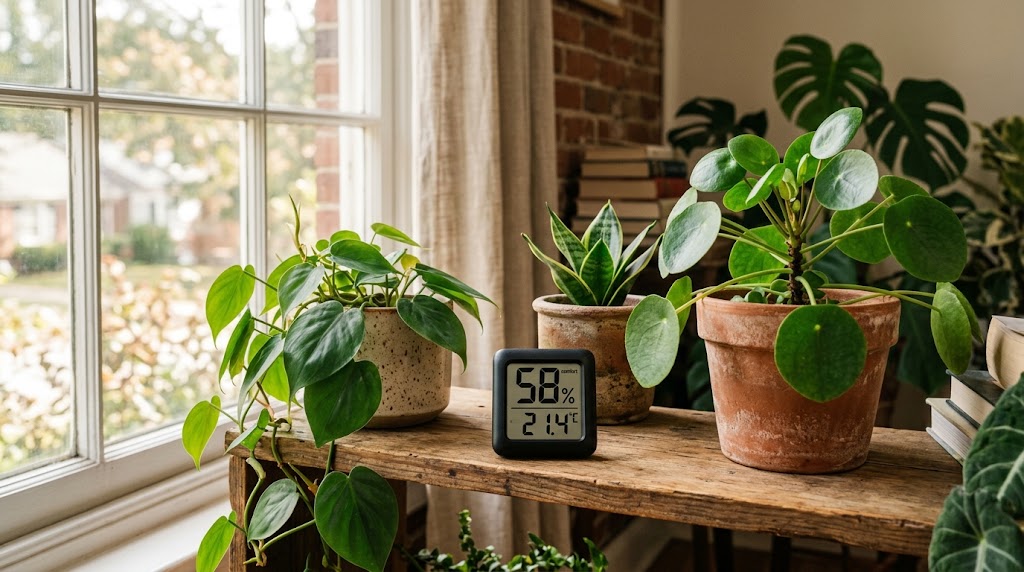
Finding the best hygrometers for indoor plants solves a problem most plant owners don’t realize they have: guessing at humidity instead of actually knowing it. You can mist, group plants together, or run a humidifier all you want, but without a hygrometer, you’re working blind — no way to tell if any of it is actually moving the number, or by how much.
Here’s why a hygrometer matters, what to look for, and our top picks. Some of the links below are affiliate links — if you buy through them, we may earn a small commission at no extra cost to you.
Quick Answer
A basic digital hygrometer, priced around $10-20, is enough for most home plant collections — you don’t need an expensive weather station. Place it at leaf-canopy height near your plants, away from windows, vents, radiators, and direct humidifier mist, and give it about 30 minutes to settle before trusting the reading. Most tropical houseplants prefer 40-60% relative humidity, while succulents and cacti generally do better on the drier end of that range or below it.
Why Measuring Humidity Actually Matters
Many popular humidity-boosting habits — misting especially — feel productive without necessarily doing much. As we covered in our guide on plant misters and what misting actually does, a quick spray raises humidity only until the water evaporates, often within minutes. Without a hygrometer, there’s no way to know whether your actual humidity-boosting methods — pebble trays, grouping plants, a humidifier — are working, or just feel like they should be.
According to the University of New Hampshire Extension, most houseplants (aside from cacti, succulents, and a few other drought-adapted species) prefer roughly 40% to 60% relative humidity — a hygrometer is the only reliable way to know where your space actually falls in that range.
Where to Place a Hygrometer for an Accurate Reading
Placement matters more than most people expect. A hygrometer set in the wrong spot doesn’t give bad data about the room — it gives accurate data about a location that has nothing to do with where your plants actually live.
- Position it at leaf-canopy height, in the open air around your plants, not tucked behind foliage.
- Keep it away from cold windows, direct sun, grow-light heat, radiators, and air conditioning vents — all of these skew the reading locally.
- Don’t place it directly above wet soil or in the path of a humidifier’s mist plume, since both will show artificially high numbers.
- After moving it to a new spot, wait at least 30 minutes before trusting the reading, since sensors take time to adjust.
What Humidity Range Your Plants Actually Want
Most general advice says “aim for 40-60%” and stops there, but that range misses plants on either end — humidity-loving tropicals that struggle at the low end, and succulents that dislike the high end. It’s also worth knowing that most homes naturally sit within a comfortable range for humans, too: the EPA recommends keeping indoor relative humidity between 30-50% to avoid condensation and mold issues, which happens to overlap well with what many common houseplants prefer.
If a particular plant wants humidity higher than what’s safe for the room overall, a small enclosed space — like a terrarium — is usually a cleaner fix than trying to raise the humidity of an entire room.
What to Look for in a Hygrometer
- Digital display. Easier and faster to read at a glance than an analog dial.
- Quick update speed. A sensor that refreshes every few seconds is more useful for tracking real-time changes than one that lags behind.
- Temperature reading included. Most digital hygrometers show both humidity and temperature, which helps you spot patterns (like humidity dropping whenever the heat kicks on).
- Stable base or magnetic back. Lets it sit securely on a shelf or attach to a metal surface near your plants.
Our Picks
Best Overall: Digital Hygrometer with Temperature Display
A simple, accurate digital unit that shows both humidity and temperature at a glance — everything most plant collections need, without paying for features you won’t use.
Best with Daily High/Low Tracking: Hygrometer with Min/Max Memory
Tracks the highest and lowest humidity readings over the day, which is genuinely useful for spotting swings — like a big drop every afternoon when the heat runs — that a single spot-check would miss entirely.
Best for Multiple Rooms: Digital Hygrometer 3-Pack
A set of three lets you compare humidity across different rooms or plant groupings at once, which is the fastest way to figure out which spots in your home are actually good for humidity-loving plants.
Common Hygrometer Mistakes to Avoid
- Checking once and assuming it’s constant. Humidity swings throughout the day, especially with heating and cooling cycles — compare readings over a full day rather than reacting to one number.
- Placing it too close to a humidity source. A spot right next to a humidifier or a freshly misted plant will show a number that doesn’t reflect the rest of the room.
- Using room humidity to judge a terrarium. Enclosed spaces need their own dedicated reading, since they behave completely differently from the open room around them.
Final Thoughts on the Best Hygrometers for Indoor Plants
A hygrometer won’t fix a humidity problem on its own, but it turns guesswork into an actual plan — showing you whether your plant corner runs dry, swings wildly through the day, or is already in a good range without any extra effort. For $10-20, it’s one of the clearest, most useful upgrades you can make to how you actually understand your plants’ environment.
Read Next
- How to Raise Humidity for Indoor Plants Without Making Your Home Damp
- Best Plant Misters for Indoor Plants
- How to Build a Terrarium: Step-by-Step Guide

Cosmin Stefanoiu is the founder and editor of The Leafy Room, a practical guide focused on indoor plants, plant care, pots and planters, small-space gardening, and thoughtful plant styling.
He creates clear, beginner-friendly editorial guides designed to help readers choose plants, understand everyday care, and make practical decisions for real homes.
Pingback: Best Humidifiers for Indoor Plants