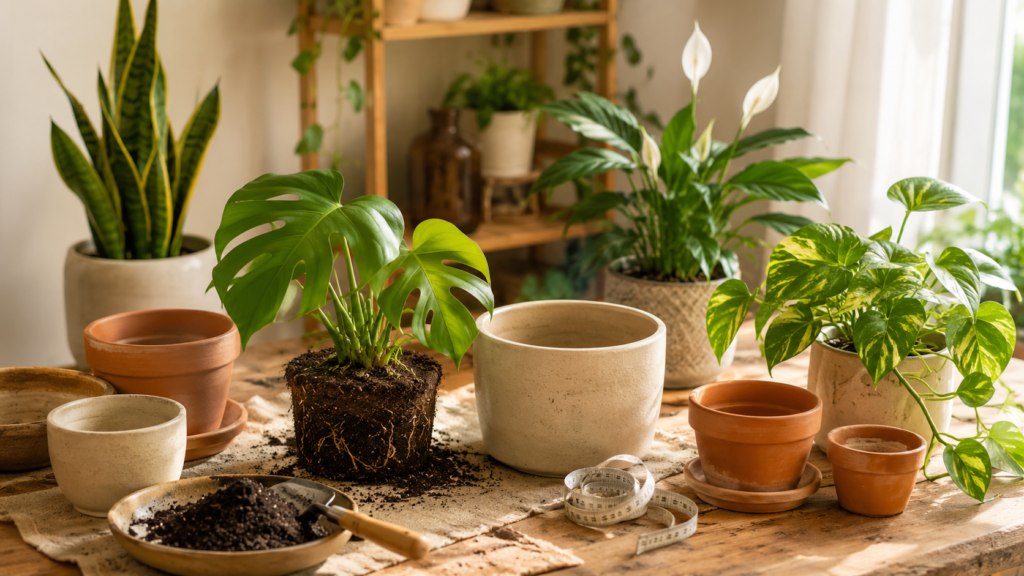
Choosing the right pot size for an indoor plant sounds simple.
You find a pot you like, move the plant into it, add soil, and hope it grows better.
But pot size can affect much more than the way a plant looks. It can change how quickly the soil dries, how stable the plant feels, how easily roots settle, and how often you need to water. A pot that is too small can crowd the roots. A pot that is too large can hold too much wet soil around a small root system.
The goal is not to choose the biggest pot available. The goal is to choose the next useful size.
A right-size pot should give the roots room to grow while still helping the soil dry at a healthy pace.
Quick Answer
For most indoor plants, choose a new pot that is only 1 to 2 inches wider in diameter than the current pot. Small plants usually need a modest size increase, while larger, heavier plants may need a pot that is wider, deeper, and more stable.
Avoid moving a small plant into a very large pot. Extra soil can stay wet too long, which may create root problems. Also avoid keeping a plant in a pot that is too small if roots are circling tightly, the plant dries out very fast, or growth has clearly slowed.
The best pot size gives the roots breathing room, supports steady growth, drains well, and keeps the plant stable.
Why Pot Size Matters
Pot size affects the balance between roots, soil, moisture, and air.
When a pot is the right size, the plant’s roots can grow into fresh soil without being surrounded by too much unused potting mix. Water can move through the container more evenly. The plant also has a better chance of staying upright and stable.
When the pot is wrong, care becomes harder.
A pot that is too small may dry out very fast. A pot that is too big may stay wet for too long. A pot that is too shallow may not support the plant well. A pot that is too tall or narrow may tip easily if the plant has heavy leaves.
Pot size is not only a design choice. It is part of the plant’s care system.
The Simple Pot Size Rule
For many common houseplants, the safest rule is:
Move up only 1 to 2 inches wider than the current pot.
For example:
- a plant in a 4-inch pot often moves to a 5-inch or 6-inch pot;
- a plant in a 6-inch pot often moves to an 8-inch pot;
- a plant in an 8-inch pot may move to a 10-inch pot if the root system is ready.
This is a general guide, not a strict rule for every plant. Some plants prefer staying snug. Some large plants need more stability. Some plants have shallow roots and do not need a deep container.
Still, the 1 to 2 inch rule helps prevent one of the most common beginner mistakes: choosing a pot that is far too large.
Why a Bigger Pot Is Not Always Better
It is easy to assume that a bigger pot means more room and better growth.
But indoor plants do not always respond well to a dramatic pot size jump.
When a small root system is placed in a much larger container, there is a lot of soil that the roots do not yet use. That extra soil can stay wet for longer after watering. If the plant cannot take up moisture quickly enough, the potting mix may remain soggy around the roots.
This can make watering harder to judge.
The plant may look like it needs help, but the issue may not be the plant itself. The pot may simply be too large for the current root system.
A better approach is gradual sizing. Let the plant grow into the next pot, then move up again later when needed.
Signs the Current Pot Is Too Small
A plant can stay in the same pot for a long time, but eventually the roots may need more space.
Signs that the pot may be too small include:
- roots circling tightly around the root ball;
- roots growing through drainage holes;
- soil drying much faster than usual;
- the plant wilting soon after watering;
- growth slowing even when light and care are suitable;
- the plant becoming top-heavy or unstable;
- water running straight through the pot without soaking evenly;
- the root ball lifting out of the pot easily.
One sign alone does not always mean the plant must be repotted immediately. For example, soil can dry fast because of heat, strong light, or a very airy potting mix.
But if several signs appear together, the plant may be ready for a slightly larger pot.
Signs the Pot Is Too Big
A pot that is too large can create different problems.
Signs that the pot may be too big include:
- soil staying wet for many days;
- the surface looking dry while the lower soil remains very wet;
- leaves yellowing after repotting;
- growth slowing after moving into a larger pot;
- the plant feeling loose or unstable in the soil;
- the pot feeling heavy for a long time after watering;
- a small plant sitting in a large amount of unused soil.
This does not mean every large pot is bad. Large plants need larger containers.
The problem happens when the pot is much larger than the root system.
What “Just Right” Looks Like
A right-size pot usually feels balanced.
The plant has room for fresh soil around the root ball, but the container does not look oversized. The pot feels stable. Water can drain properly. The soil dries at a reasonable pace for that plant type.
A good pot fit usually has:
- a little room around the root ball;
- enough depth for the roots;
- drainage holes or a safe drainage setup;
- a stable base;
- enough weight to support the plant;
- no huge volume of unused soil;
- space for growth without drowning the roots in extra mix.
The best pot should feel slightly larger, not dramatically bigger.
Check the Root Ball Before Choosing
The best way to choose a pot size is to look at the root ball.
Gently slide the plant out of its current pot when the soil is slightly dry or only lightly moist. Look at the roots and soil shape.
You may see one of three situations.
1. Roots are loose and soil falls apart easily
The plant may not need a larger pot yet.
If roots are not filling the current container, moving up may be too soon. Refreshing the top layer of soil or improving care may be enough.
2. Roots hold the soil together but are not packed tightly
This can be a good time for a small pot size increase.
Choose a pot that is only slightly wider and gives the plant fresh soil around the root ball.
3. Roots circle tightly around the outside
The plant may be root-bound.
A slightly larger pot is usually helpful. Loosen the outer roots gently if needed, then move the plant into the next size up.
Measure Width, Not Just Height
Pot size is usually discussed by diameter, not height.
The diameter is the width across the top of the pot. When people say “move from a 6-inch pot to an 8-inch pot,” they usually mean the top diameter.
Depth still matters, but width is often the easier starting point.
A pot can be wide and shallow, tall and narrow, or balanced. The right choice depends on the plant’s root habit and the shape of the plant above the soil.
Pot Depth Matters Too
Some plants need deeper pots because they develop stronger or deeper roots. Others do better in shallower containers.
As a general guide:
- Snake Plants often prefer a sturdy pot that is not unnecessarily deep.
- ZZ Plants need stability and room for thick underground structures.
- Pothos and Philodendron usually do well with moderate depth and good drainage.
- Peace Lilies often need a pot that supports moisture balance without staying swampy.
- Succulents and cacti usually prefer snug pots with excellent drainage.
- Large floor plants need enough depth and weight to stay stable.
A very deep pot can hold extra moisture in the lower soil, especially if the plant has a smaller root system.
Drainage Is More Important Than Style
A beautiful pot is not enough if drainage is poor.
Indoor plants usually need a way for excess water to leave the root zone. This can mean:
- a pot with drainage holes;
- a nursery pot placed inside a decorative cachepot;
- a saucer under a draining pot;
- removing the inner pot to water and drain before placing it back.
A pot without drainage can work only if you are very careful with water, but it is much less forgiving.
For most beginners, drainage holes make plant care easier and safer.
If you love a decorative pot with no holes, use it as an outer cover pot and keep the plant in a plastic nursery pot inside.
Stability Matters for Tall Plants
Pot size is not only about roots.
A tall or top-heavy plant needs stability.
Plants like Rubber Plant, Bird of Paradise, Monstera, Fiddle Leaf Fig, and larger Dracaena may need a heavier or wider pot so they do not tip over. A narrow lightweight pot may look elegant, but it can be frustrating if the plant leans or falls.
For tall plants, look for:
- a wider base;
- enough pot weight;
- balanced depth;
- a pot that does not wobble;
- a plant position that does not pull the weight to one side.
If the plant is tall but the root system is not huge, choose stability carefully without adding too much extra soil.
Pot Size Tips by Plant Type
Different indoor plants have different pot needs.
Pothos and Philodendron
Trailing plants like Pothos and Heartleaf Philodendron usually do not need a huge pot.
They often do best with a modest size increase. A pot that is too large can keep the soil wet longer than necessary.
Choose a pot that gives roots room but still lets the soil dry at a steady pace. If the vines are long but the root ball is still modest, do not choose a huge pot just because the plant looks large above the soil.
For more trailing plant ideas, see Silver Satin Pothos: The Trailing Plant With Silver-Splashed Leaves.
Snake Plant
Snake Plant often prefers a snug, stable pot.
It does not usually need a dramatic size increase. A pot that is too deep or too large can hold extra moisture around the roots.
Choose a firm container with good drainage and enough width for the plant’s growth. Stability matters because tall leaves can make the plant lean if the pot is too light.
ZZ Plant
ZZ Plant has thick underground structures and glossy upright growth.
It needs a pot that supports stability and drainage. Do not rush to place it in a much larger container. A gradual size increase is usually better.
Choose a sturdy pot that allows the roots to expand without leaving too much unused soil.
Peace Lily
Peace Lily usually likes consistent moisture, but it should not sit in soggy soil.
A right-size pot helps moisture stay more balanced. Too small, and the plant may dry too quickly. Too large, and the soil may stay wet for too long.
Choose a pot that is only slightly larger than the root system and make sure drainage is reliable.
Monstera
Monstera can grow large, but young or medium plants still need gradual pot increases.
A pot that is too large can hold extra soil around the roots. A pot that is too light may also become unstable as the leaves get bigger.
Choose a pot that gives the roots room, supports the plant’s weight, and allows future support if you use a moss pole or stake.
Succulents and Cacti
Succulents and cacti usually prefer snug containers and fast-draining setups.
Too much soil can stay wet longer than the roots prefer. For these plants, drainage and soil type are just as important as pot size.
Choose a small size increase and avoid deep, oversized pots unless the plant truly needs the space.
Ferns
Ferns often prefer more consistent moisture, but that does not mean they need a large pot.
A pot that is too big may still hold too much water. Choose a container that supports even moisture without staying waterlogged.
For small ferns, a modest pot size and good humidity often matter more than extra pot volume.
What About Decorative Cachepots?
A cachepot is a decorative outer pot.
Many indoor plant owners keep the plant in its nursery pot and place that inside a nicer cover pot. This can be a practical option because you can remove the inner pot for watering and let it drain fully before putting it back.
This setup works well if:
- the nursery pot fits comfortably inside;
- there is no standing water at the bottom;
- the plant is easy to remove for watering;
- the outer pot is stable;
- you check moisture instead of guessing.
The danger is hidden water. If water collects inside the decorative pot, roots may sit in wet conditions without you noticing.
Should You Repot Right After Buying a Plant?
Not always.
A new plant may already be adjusting to a new room, new light, and a new watering routine. Repotting immediately can add more stress.
It may be better to wait if:
- the plant looks healthy;
- the pot is not clearly too small;
- the soil is drying normally;
- roots are not heavily circling;
- the plant is not unstable;
- you are still learning its care needs.
You may need to repot sooner if the plant is very root-bound, the pot has poor drainage, or the soil quality is causing problems.
How to Choose the Next Pot Step by Step
Use this simple process:
- Check the current pot diameter.
- Gently inspect the root ball.
- Look for circling roots or roots coming through drainage holes.
- Choose a pot only 1 to 2 inches wider for most plants.
- Make sure the pot has drainage or can hold a nursery pot safely.
- Check that the pot depth matches the plant’s root system.
- Choose a stable base if the plant is tall or heavy.
- Add fresh potting mix around the root ball without burying the plant too deeply.
- Water carefully after repotting and let excess water drain.
This approach keeps the plant supported without overwhelming the roots.
Common Pot Size Mistakes
Choosing a pot for looks only
A pot can be beautiful but still wrong for the plant.
Always check drainage, depth, width, and stability.
Going too large too fast
A large pot may look generous, but it can hold excess wet soil.
Choose the next size up, not the biggest pot on the shelf.
Ignoring drainage
Pot size cannot fix poor drainage.
Even the right-size pot can cause problems if water has nowhere to go.
Repotting too often
Repotting is useful when the plant needs it, not every time you want a new look.
If the plant is healthy and roots are not crowded, it may not need a new pot yet.
Treating every plant the same
Snake Plants, Peace Lilies, Pothos, ZZ Plants, Monstera, and succulents do not all want the same pot style.
Match the container to the plant’s growth habit.
Forgetting the weight of the plant
A tall plant in a light pot may become unstable.
Choose a pot that supports the full plant, not only the roots.
A Simple Pot Size Checklist
Before choosing a new pot, ask:
- Is the plant actually root-bound?
- Is the current soil drying too fast or too slowly?
- Does the plant need more root room or just better care?
- Is the next pot only slightly larger?
- Does the new pot have drainage?
- Is the pot stable enough?
- Is the pot too deep for the plant?
- Will the plant be easier or harder to water in this pot?
- Does the plant type prefer snug roots or more room?
This checklist can prevent many repotting mistakes.
Final Thoughts
The right pot size helps indoor plants grow with fewer care problems.
A bigger pot is not automatically better. A smaller pot is not always bad. The best choice depends on the root system, plant type, drainage, moisture needs, and stability.
For most indoor plants, the safest move is a small size increase: usually 1 to 2 inches wider than the current pot.
Choose enough room for healthy roots, but not so much extra soil that the plant stays wet for too long.
A good pot should support the plant quietly. It should help roots grow, moisture balance, and the plant stand steady.
If you are unsure, choose the smallest pot that still gives the roots room to grow.
Read Next
- Terracotta vs Ceramic Pots: Which Is Better for Your Plants?
- When to Repot Indoor Plants: Signs Your Plant Needs a Bigger Home
- Don’t Water Yet: How to Check Indoor Plants Before Watering
- Best Indoor Plant Tools for Beginners: What You Actually Need
- Silver Satin Pothos: The Trailing Plant With Silver-Splashed Leaves

Cosmin Stefanoiu is the founder and editor of The Leafy Room, a practical guide focused on indoor plants, plant care, pots and planters, small-space gardening, and thoughtful plant styling.
He creates clear, beginner-friendly editorial guides designed to help readers choose plants, understand everyday care, and make practical decisions for real homes.