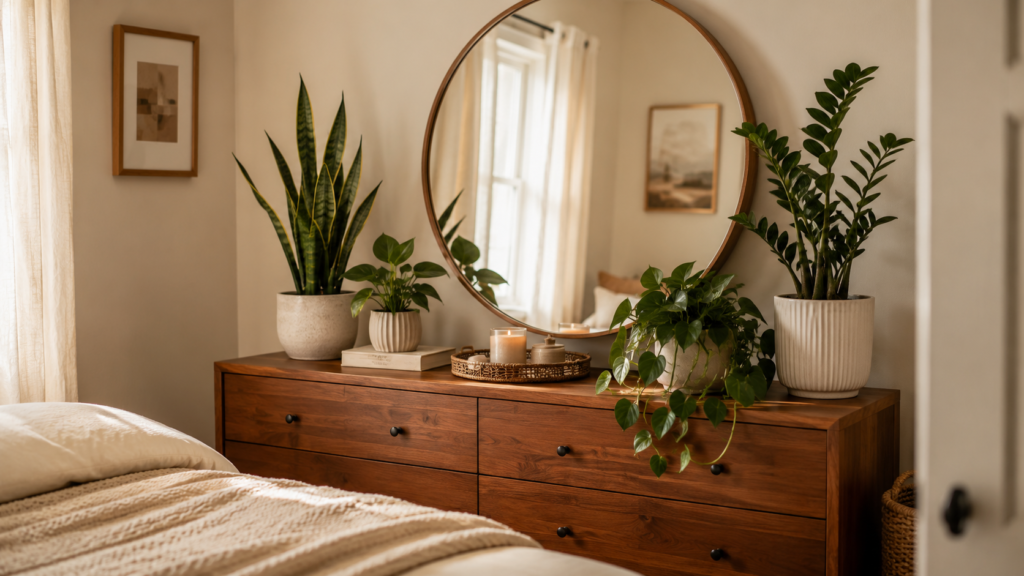
A dresser can be one of the easiest places to style plants.
It already has height, a flat surface, and often a mirror or wall space behind it. With the right plant choices, a dresser can make a bedroom, guest room, hallway, or dressing area feel softer and more alive.
But it can also become messy very quickly.
Too many small pots, mismatched containers, trailing leaves covering the mirror, or plants placed without checking the light can make the dresser look crowded instead of styled.
The best dresser plant styling is simple. It usually needs only a few plants, one clear anchor, one softer shape, coordinated pots, and enough empty surface space so the dresser still feels calm and useful.
Quick Answer
To style plants on a dresser without making it look messy, use 2 to 4 plants at most. Start with one taller anchor plant, add one trailing or rounded plant, include one small accent plant if there is enough space, and group smaller decor pieces on a tray.
Keep pot colors related, avoid blocking the mirror, and leave part of the dresser surface empty. A styled dresser should feel balanced, not packed.
Start With the Dresser Surface
Before choosing plants, look at the dresser itself.
A wide dresser can handle more visual weight than a narrow dresser. A low dresser may need height from one taller plant. A dresser under a mirror needs space around the reflection. A dresser near a window can support more plant options than a dresser in a darker corner.
Ask yourself:
- How wide is the dresser?
- Is there a mirror above it?
- Does the dresser receive natural light?
- Do you still need space for daily items?
- Is the dresser in a bedroom, entryway, hallway, or guest room?
- Is the top already busy with candles, books, perfume, frames, or trays?
- Would plants make the surface feel calmer or more crowded?
The goal is not to decorate every inch. The goal is to make the dresser look finished while still feeling easy to live with.
Choose One Main Styling Zone
A common mistake is spreading plants across the entire dresser.
This often makes the surface look cluttered, even if each plant is attractive on its own. Instead, choose one main zone.
You can style:
- one side of the dresser;
- the center area under a mirror;
- one corner near a lamp;
- a small tray arrangement;
- a plant grouping beside framed art.
For most dressers, styling one side works best. It leaves useful empty space and keeps the arrangement from feeling too heavy.
If you have a large mirror, try framing one side of the mirror with plants instead of covering the mirror itself.
The Easy Dresser Plant Formula
A simple dresser plant display usually works best with four parts:
- one taller anchor plant;
- one trailing or softer plant;
- one small accent plant;
- one tray, book stack, candle, or simple decor piece.
This gives the dresser height, softness, detail, and structure without making it feel overloaded.
1. Start With One Taller Anchor Plant
The anchor plant gives the display structure.
This does not have to be a huge floor plant. On a dresser, the anchor should usually be tall enough to create height but not so wide that it takes over the whole surface.
Good dresser anchor plants include:
- Snake Plant;
- ZZ Plant;
- small Rubber Plant;
- compact Peace Lily;
- small Bird of Paradise if the dresser is large;
- upright Philodendron;
- compact Ficus variety.
The anchor plant usually looks best on one side of the dresser, especially if there is a mirror or framed art behind it.
If the dresser is narrow, choose a plant with vertical growth rather than wide leaves.
2. Add a Softer Shape
Once the anchor plant is in place, add softness.
A trailing or rounded plant helps the dresser feel less stiff. It can soften the hard lines of wood, mirror frames, lamps, and drawers.
Good softer plants include:
- Pothos;
- Heartleaf Philodendron;
- Peperomia;
- Prayer Plant;
- small Calathea;
- String of Hearts;
- Hoya;
- African Violet.
A trailing plant can look beautiful on a dresser, but keep it controlled. A few vines look relaxed. Long vines covering drawers, handles, or mirrors can feel messy.
If you like trailing plants in small rooms, you may also like this guide to best hanging plants for small rooms.
3. Use One Small Accent Plant
A small accent plant can make the dresser feel layered.
This could be:
- a Peperomia;
- African Violet;
- small Pothos cutting;
- small Prayer Plant;
- compact fern;
- small Hoya;
- mini Snake Plant.
The accent plant should not compete with the anchor plant. It should add detail without taking over the surface.
If the dresser is already decorated with a lamp, tray, books, candle, and mirror, you may not need an accent plant at all.
Sometimes two plants look better than four.
4. Group Small Items on a Tray
A tray is one of the easiest ways to make dresser decor look intentional.
Without a tray, small objects can look scattered. With a tray, they feel grouped.
A tray can hold:
- a small plant;
- a candle;
- a small bowl;
- a book stack;
- perfume bottles;
- a framed mini print;
- a small decorative object.
Choose a tray that matches the room. Woven trays, wooden trays, ceramic trays, and simple metal trays can all work well.
For a plant-focused dresser, a woven or light wood tray often feels warm and natural.
Leave Empty Space
Empty space is not wasted space.
It is what makes the dresser look styled instead of crowded.
Try to leave at least one clear area on the dresser. This helps the plants stand out and keeps the surface practical.
Empty space is especially important if the dresser is in a bedroom, because the room should feel restful. A dresser covered with too many pots can make the space feel busier than it needs to be.
A good rule is simple: if the dresser top looks full from edge to edge, remove one item.
Do Not Block the Mirror
If your dresser has a mirror, use plants to frame it, not hide it.
Plants can soften a mirror beautifully, but they should not cover the main reflection. A tall plant can sit to one side. A trailing plant can fall gently near the lower edge. A small plant can sit on a tray below.
Avoid placing a wide plant directly in the center of the mirror unless you want the mirror to be mostly decorative.
The mirror should still reflect light, space, and part of the room.
Match the Plants to the Light
Dresser styling should still respect plant needs.
A bedroom dresser near a window may offer bright indirect light. A hallway dresser may be much darker. A dresser across the room from a window may look bright to your eyes but still be too dim for some plants.
Bright indirect light
This works well for:
- Pothos;
- Philodendron;
- Prayer Plant;
- Peperomia;
- Peace Lily;
- Hoya;
- African Violet;
- small Rubber Plant;
- Calathea.
Bright indirect light is usually the most flexible option for dresser styling.
Medium light
This can work for:
- ZZ Plant;
- Snake Plant;
- Pothos;
- Philodendron;
- Cast Iron Plant;
- Peace Lily.
These plants can often handle less intense light, but they still need real natural brightness during the day.
Low light
Low light dressers need careful choices.
Better options include:
- Snake Plant;
- ZZ Plant;
- Cast Iron Plant;
- Pothos.
If the dresser is in a very dark room, use fewer plants and rotate them closer to a window when needed. You can also read our guide to low-light plants for small apartments for more options.
Pick Pots That Look Related
Pot choice matters a lot on a dresser because the plants sit at eye level.
The pots do not need to match exactly, but they should look connected.
Good dresser pot combinations include:
- cream ceramic and woven texture;
- terracotta and beige ceramic;
- taupe, soft green, and warm white;
- matte ceramic and light wood;
- two neutral pots with one warm accent pot.
Avoid using too many unrelated pot colors on one dresser. A black pot, bright blue pot, terracotta pot, patterned pot, and white plastic pot may all look separate instead of styled.
If you want more variety, repeat the same color family and vary the texture.
For more help choosing container materials, see Terracotta vs Ceramic Pots: Which Is Better for Your Plants?.
Best Plants for a Dresser
The best plants for a dresser are usually compact, stable, attractive from the front, and not too messy.
Pothos
Pothos is one of the easiest plants to style on a dresser.
It adds a soft trailing shape and works well beside mirrors, books, lamps, and trays. Keep the vines trimmed or guided so they do not cover drawers or handles.
Snake Plant
Snake Plant is useful when you want upright structure.
It works especially well at the side of a dresser or near a mirror. Its narrow shape gives height without spreading too much across the surface.
ZZ Plant
ZZ Plant has a clean, glossy look that suits modern bedrooms and simple dresser styling.
It is a strong option if you want something sculptural without using a plant that feels delicate or fussy.
Peperomia
Peperomia is a good dresser plant because it stays compact.
It can sit on a tray, book stack, or small empty spot without taking over the dresser. Its rounded leaves can soften the display.
Prayer Plant
Prayer Plant adds pattern and softness.
It works well when you want a fuller plant that still feels bedroom-friendly. It looks especially good with neutral pots, soft curtains, wood furniture, and warm natural light. You can read more in our Prayer Plant care guide.
African Violet
African Violet can add a small flowering detail without needing a large pot.
It is a good choice if you want color on a dresser, shelf, or small corner. See our guide to African Violet as an indoor flower for more styling and care context.
Rubber Plant
A small Rubber Plant can make a dresser feel polished and structured.
Use it only if the dresser has enough space and light. A Rubber Plant can become too visually heavy on a very narrow dresser, but it works beautifully as a simple statement on a wider surface. See our Rubber Plant guide for more ideas.
Dresser Plant Styling for Small Bedrooms
Small bedrooms need lighter styling.
Choose:
- one compact plant;
- one taller narrow plant;
- one tray;
- one small decor item;
- simple pot colors.
Avoid using many trailing plants, oversized floor-style plants, or several heavy ceramic pots on a small dresser.
A dresser in a small bedroom should still feel useful. If the plant display makes it hard to open drawers, use the mirror, or place daily items, the setup is too full.
Dresser Plant Styling With a Mirror
A mirror makes plant styling easier because it reflects light and greenery.
Try this layout:
- tall plant on one side;
- trailing or rounded plant near the center;
- tray below the mirror;
- small accent plant only if space allows.
Keep the center of the mirror open.
If you place a plant directly in front of the mirror, choose something low or narrow so it does not block the reflection.
Dresser Plant Styling Without a Mirror
If the dresser does not have a mirror, use the wall behind it.
You can add:
- one framed print;
- one botanical artwork;
- one small wall shelf;
- one lamp;
- one tall plant on the dresser;
- one trailing plant on the side.
Without a mirror, the dresser may need a stronger vertical element. A tall plant, lamp, or framed print can help the display feel complete.
Common Dresser Plant Mistakes
Using too many small pots
Several tiny pots can make the dresser look scattered.
Use fewer plants with stronger shapes instead.
Placing everything at the same height
If every plant sits directly on the dresser, the arrangement may look flat.
Raise one plant on a book stack, tray, or small stand.
Blocking the mirror
Plants should soften the mirror, not cover it completely.
Keep the main reflection visible.
Mixing too many pot styles
Too many unrelated pot colors can make the dresser feel random.
Repeat 2 or 3 finishes.
Forgetting daily use
A dresser is not just decor.
Leave space for items you actually use, especially in a bedroom.
Ignoring plant weight
Heavy ceramic pots can be risky on a narrow dresser or lightweight furniture.
Choose stable pots and avoid overloading the surface.
A Simple Dresser Formula You Can Copy
Use this easy formula:
- Choose one side or one main zone.
- Add one taller anchor plant.
- Add one softer plant with trailing or rounded leaves.
- Add one tray with a small decor item.
- Add one small accent plant only if there is room.
- Keep pot colors related.
- Leave open surface space.
- Check that the plants match the real light in the room.
This formula works because it creates a clear visual rhythm without filling the whole dresser.
Useful products:
Woven Dresser Tray
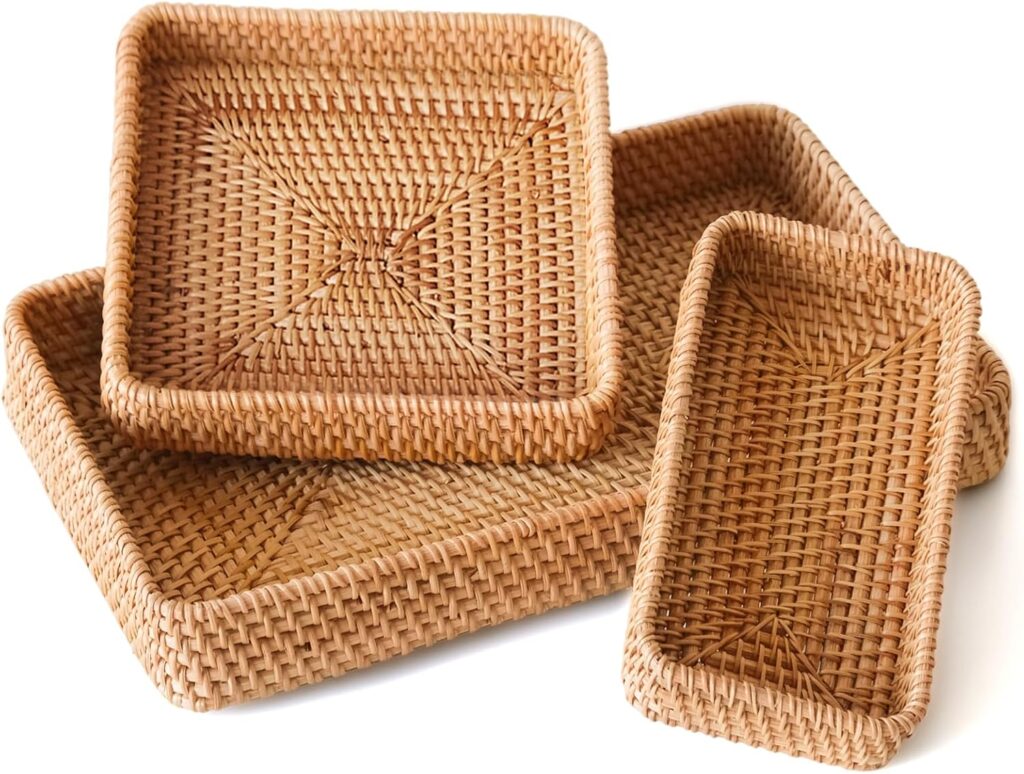
Best for: grouping a small plant, candle, book stack, or small decor item so the dresser looks styled instead of scattered.
Why it works: a tray creates one clear styling zone and keeps smaller objects from looking random across the dresser surface.
Use it for: a small peperomia, candle, framed mini print, jewelry dish, or compact pothos.
Neutral Ceramic Plant Pot
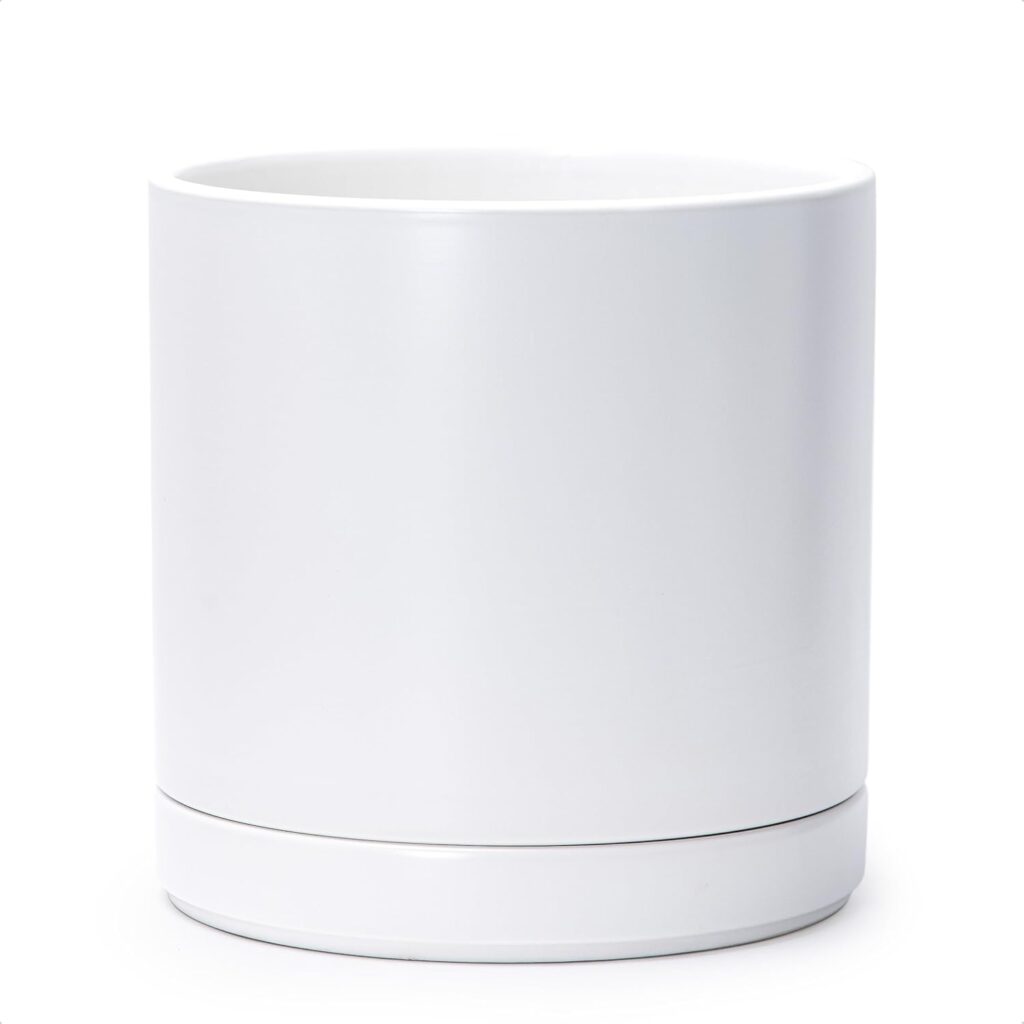
Best for: making dresser plants look cleaner and more intentional than plastic nursery pots.
Why it works: one or two matching neutral ceramic pots can connect the whole dresser display, especially with wood furniture, mirrors, cream bedding, and warm bedroom decor.
Use it for: pothos, peperomia, prayer plant, small ZZ plant, or African violet.
Final Thoughts
Plants can make a dresser feel softer, warmer, and more finished.
The key is restraint. You do not need ten plants. In most rooms, 2 to 4 plants are enough.
Start with one anchor, add one softer shape, use a tray to group small objects, repeat pot colors, and leave visible empty space.
A well-styled dresser should still feel calm and useful.
If it feels messy, remove one plant. If it feels flat, add height. If it feels random, simplify the pot colors.
The best dresser plant styling feels natural, balanced, and easy to live with.
Read Next
- Plant Shelf Makeover: How to Style Indoor Plants Without Clutter
- Best Hanging Plants for Small Rooms
- Best Low Light Plants for Small Apartments
- Terracotta vs Ceramic Pots: Which Is Better for Your Plants?
- Prayer Plant Care: How to Grow Maranta Indoors

Cosmin Stefanoiu is the founder and editor of The Leafy Room, a practical guide focused on indoor plants, plant care, pots and planters, small-space gardening, and thoughtful plant styling.
He creates clear, beginner-friendly editorial guides designed to help readers choose plants, understand everyday care, and make practical decisions for real homes.