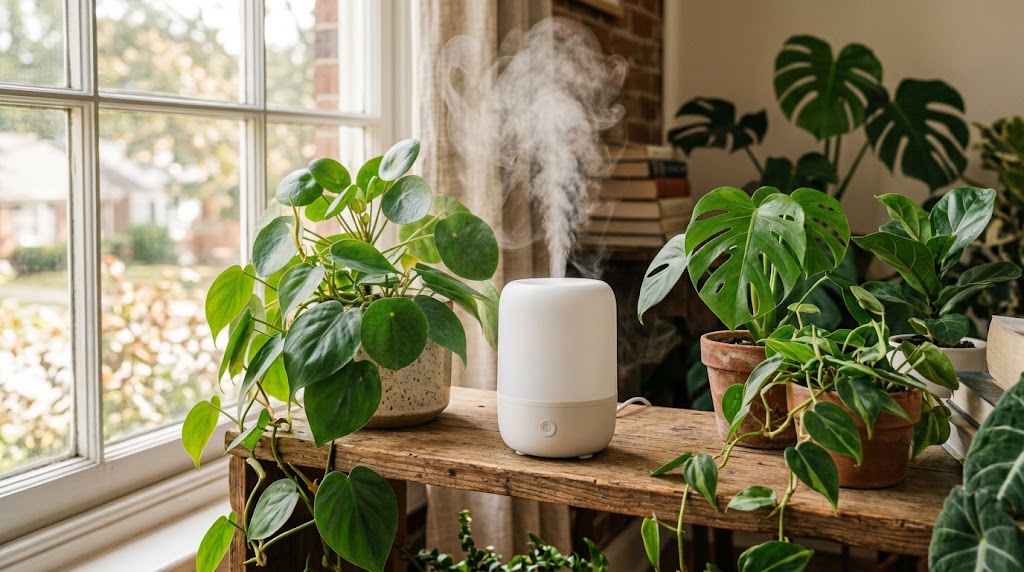
Finding the best humidifiers for indoor plants is the real fix once you’ve realized misting alone doesn’t do much for humidity. Unlike a quick spray that evaporates in minutes, a humidifier provides steady, sustained moisture — the kind tropical plants actually need to thrive through dry winter months.
Here’s how to choose the right type, what to look for, and our top picks. Some of the links below are affiliate links — if you buy through them, we may earn a small commission at no extra cost to you.
Quick Answer
Cool mist ultrasonic humidifiers are the best choice for most indoor plant collections. They raise humidity effectively without altering room temperature, which matters since temperature-sensitive tropicals like calathea and ferns can be stressed by the heat plume a warm mist unit produces nearby. Choose a size based on the room, not just the number of plants — a small humidifier in a large room will struggle to move the needle no matter how many plants surround it.
Cool Mist vs. Warm Mist: Which Is Better for Plants
Both types raise humidity, but they get there differently, and the difference matters for plants specifically:
- Cool mist humidifiers disperse water at room temperature, so they don’t create local temperature swings. Testing from plant-focused reviewers has shown a cool mist unit can raise humidity from around 35% to 55-58% within a few hours in a mid-sized room, staying stable afterward.
- Warm mist humidifiers boil water before releasing it as vapor, which kills bacteria in the tank but also raises the local temperature by several degrees within a couple feet of the unit. For heat-sensitive tropicals, that thermal swing can cause stress or leaf curling if the plant sits too close.
For most plant collections, cool mist is the safer default. Warm mist has a legitimate use case during especially harsh winter heating, when a cool mist unit alone may struggle to keep up — but even then, placing plants a few feet away from the unit reduces the risk.
How Ultrasonic Humidifiers Actually Work
Most modern cool mist humidifiers use ultrasonic technology — a small transducer vibrating at a very high frequency to break water into micro-fine droplets, which evaporate quickly into the surrounding air without leaving visible moisture on nearby surfaces or leaves. This is different from misting a plant directly, which wets the leaf surface itself rather than raising ambient humidity.
What Size and Type to Look For
- Room coverage, not plant count. Check the manufacturer’s stated square footage coverage and match it to the actual room, not just how many plants are in it.
- Adjustable mist output. Being able to dial down output on smaller or more humid days prevents overshooting into damp, mold-friendly territory.
- Large enough tank. A bigger tank means fewer refills, especially useful if you want it running for several hours a day.
- Easy-to-clean design. Reservoirs can develop mineral buildup or mold over time — a wide opening and simple parts make regular cleaning far less of a chore.
Our Picks
Best Overall: Cool Mist Ultrasonic Humidifier
A reliable cool mist unit with adjustable output and a large enough tank to run through a full day without frequent refills — a solid all-around choice for a plant-filled room.
Best for Small Spaces: Compact Cool Mist Humidifier
Sized for smaller rooms or a single plant shelf, without paying for coverage you don’t need or taking up more counter space than necessary.
Best with Humidity Sensor: Smart Humidifier with Built-In Hygrometer
Automatically adjusts output based on a built-in humidity sensor, taking the guesswork out of finding the right setting — though a separate dedicated hygrometer near your plants still gives the most accurate localized reading.
How to Place a Humidifier for Best Results
- Keep the unit in the same room as your humidity-loving plants, but not so close that moisture condenses directly on the leaves.
- For warm mist models specifically, keep temperature-sensitive plants at least a few feet away to avoid the heat plume.
- Use distilled or filtered water when possible — tap water minerals can create a white, powdery residue on nearby surfaces and leaves over time.
- Run it for a few hours during the day rather than 24/7, which is usually enough to meaningfully raise humidity without oversaturating the room.
For a room with mixed plant types, remember that not everything wants the same conditions — as we covered in our guide on measuring humidity for indoor plants, tropicals and succulents often have opposite preferences, so it’s worth grouping plants by humidity need rather than treating the whole room the same.
Common Mistakes to Avoid
- Running it non-stop without monitoring. Overdoing humidity can encourage mold and fungal issues just as easily as underdoing it can stress plants.
- Skipping regular cleaning. A neglected reservoir can grow mold or bacteria, which then gets released into the air along with the mist.
- Placing it too close to electronics or wood furniture. Sustained moisture nearby can cause damage over time — keep some distance from anything humidity-sensitive besides your plants.
Final Thoughts on the Best Humidifiers for Indoor Plants
A good humidifier does what misting alone can’t — steady, sustained humidity instead of a brief spike that’s gone in minutes. Choose cool mist for most plant collections, size it to the actual room, and pair it with a hygrometer so you’re adjusting based on real numbers instead of guessing. It’s one of the more effective upgrades you can make for humidity-loving tropicals getting through a dry winter.
Read Next
- Best Hygrometers for Indoor Plants
- Best Plant Misters for Indoor Plants
- How to Raise Humidity for Indoor Plants Without Making Your Home Damp

Cosmin Stefanoiu is the founder and editor of The Leafy Room, a practical guide focused on indoor plants, plant care, pots and planters, small-space gardening, and thoughtful plant styling.
He creates clear, beginner-friendly editorial guides designed to help readers choose plants, understand everyday care, and make practical decisions for real homes.