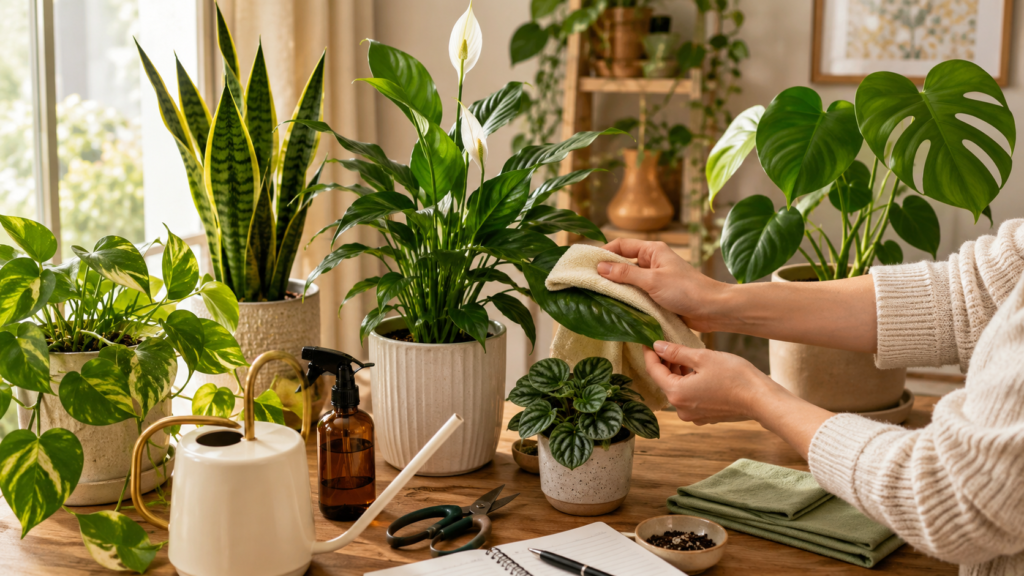
Indoor plant care becomes much easier when you stop guessing.
Many beginners try to care for plants randomly. They water when they remember, wipe leaves only when they look dusty, repot when a plant looks sad, or move plants only after something goes wrong.
A better routine is simple, calm, and repeatable.
You do not need to spend hours every week. For most indoor plant collections, a short weekly check can prevent many common problems before they become serious. The goal is not to water every plant on the same day. The goal is to look at each plant, understand what it needs, and only do the care that actually helps.
A good weekly indoor plant care routine should help you check soil, leaves, light, pests, drainage, and overall plant placement without turning plant care into a stressful chore.
Quick Answer
A simple weekly indoor plant care routine should include checking soil moisture, watering only the plants that need it, inspecting leaves and stems, looking for early pest signs, rotating pots for even growth, emptying saucers after watering, and wiping dusty leaves when needed.
The most important rule is this: do not water every plant on the same schedule. Check each plant first, then decide what it actually needs.
A weekly routine should take about 10 to 15 minutes for a small plant collection and a little longer for a larger one.
Why a Weekly Routine Works Better Than Random Care
Plants usually show small signs before a problem becomes obvious.
A leaf may start yellowing. Soil may stay wet longer than usual. A plant may lean toward the window. A pot may become unstable. Dust may collect on large leaves. A saucer may hold leftover water. A plant may start growing weakly because the light changed with the season.
If you only notice plants when they look bad, you may miss the early signs.
A weekly routine helps because it gives you a regular moment to observe your plants before problems get bigger.
It also stops one of the most common beginner habits: watering everything just because it is “plant care day.”
Pick One Weekly Plant Care Day
Choose one day each week for a quick plant check.
This does not mean you water every plant on that day. It only means you inspect your plants on that day.
For many people, the best time is:
- Saturday morning;
- Sunday afternoon;
- one weekday evening;
- the same day you clean your room;
- the same day you check your planner or home tasks.
Keeping the day consistent helps plant care become a habit.
If you forget occasionally, that is fine. The point is to create a rhythm, not a strict rule.
Start With a Walk-Through
Before you touch a watering can, walk through your plant area.
Look at your plants from a normal distance first. This helps you notice general changes.
Ask yourself:
- Does any plant look droopy?
- Are any leaves yellowing?
- Is any plant leaning strongly toward the light?
- Is one plant growing faster than the others?
- Does any pot look unstable?
- Are there fallen leaves on the soil or floor?
- Are any leaves touching a cold window?
- Is any plant too close to a heater, vent, or air conditioner?
This first check should be quick. You are not solving everything yet. You are just noticing what needs attention.
Check Soil Before Watering
Soil check comes before watering.
This is the most important part of a weekly plant care routine.
Do not water because the calendar says it is time. Water because the plant and soil say it is time.
Use your finger to check the soil. For many common houseplants, the top layer may dry before the lower soil does. That means a pot can look dry on top while still holding moisture below.
Check:
- whether the top inch feels dry;
- whether the lower soil still feels damp;
- whether the pot feels unusually heavy;
- whether the soil has pulled away from the pot;
- whether water runs through too quickly;
- whether the plant is drying faster than normal.
If the soil is still moist and the plant looks fine, do not water yet.
For a full guide, read Don’t Water Yet: How to Check Indoor Plants Before Watering.
Water Only the Plants That Need It
A good routine does not mean every plant gets water.
Different plants dry at different speeds.
A small pothos near a bright window may need water sooner than a snake plant in a lower-light corner. A peace lily may show thirst faster than a ZZ plant. A plant in terracotta may dry faster than one in glazed ceramic. A plant in a small pot may dry faster than one in a large pot.
Watering all plants on the same day can easily lead to overwatering some of them.
Instead, divide plants into simple groups:
- dry and ready to water;
- still slightly moist;
- wet and should be left alone;
- problem plants that need closer checking.
Only water the first group.
Empty Saucers After Watering
After watering, check the saucers and cover pots.
Do not leave plants sitting in extra water.
Standing water can keep the bottom of the pot too wet and may make root problems more likely. It can also leave marks on furniture, trays, shelves, and floors.
After watering:
- Let the plant drain.
- Check the saucer or outer pot.
- Empty extra water.
- Put the plant back in place.
- Check again later if the pot drains slowly.
This small step can prevent many watering problems.
Inspect Leaves and Stems
Leaves tell you a lot.
Each week, look at both the top and underside of leaves. You do not need to inspect every leaf perfectly, but you should look closely enough to notice changes.
Check for:
- yellow leaves;
- brown tips;
- crispy edges;
- curling leaves;
- pale new growth;
- black or mushy spots;
- dusty leaf surfaces;
- torn or damaged leaves;
- sticky residue;
- tiny dots or webbing;
- weak or stretched stems.
One yellow leaf is not always a disaster. Older leaves naturally age. But repeated yellowing, sudden changes, or several symptoms together deserve attention.
Look for Early Pest Signs
Pest checks are easier when they are quick and regular.
Many pest problems are easier to handle when noticed early. Look especially under leaves, along stems, near new growth, and where leaves meet the main stem.
Watch for:
- tiny moving insects;
- sticky residue;
- fine webbing;
- small white cottony spots;
- dots on leaves;
- damaged new growth;
- leaves that look speckled or weak.
Do not panic if you see a problem. First, isolate the plant from the rest of your collection and identify what you are dealing with. If the issue is severe or you are unsure, ask a qualified plant professional or local garden center for advice.
The weekly goal is simple: notice early.
Rotate Plants for Even Growth
Many indoor plants lean toward the window over time.
A gentle rotation helps the plant grow more evenly.
Once a week, turn pots slightly. You do not need a dramatic rotation. A small turn is usually enough.
This is especially helpful for:
- pothos;
- monstera;
- rubber plant;
- peace lily;
- pilea;
- philodendron;
- peperomia;
- prayer plant;
- many plants near windows.
Do not rotate plants constantly if they are sensitive or adjusting after being moved. But for many houseplants, a small weekly turn helps maintain a balanced shape.
Wipe Dusty Leaves
Dust can collect on broad leaves.
Dusty leaves can make plants look dull and may reduce how much light reaches the leaf surface. Wiping leaves also gives you a chance to inspect the plant closely.
Use a soft damp cloth and wipe gently.
Good plants to wipe include:
- rubber plant;
- monstera;
- peace lily;
- snake plant;
- bird of paradise;
- philodendron;
- ZZ plant;
- pothos with larger leaves.
Avoid harsh cleaning products. For delicate, fuzzy, or textured leaves, wiping may not be the best method. Use a gentle approach based on the plant type.
Remove Dead or Damaged Leaves
Dead leaves can make a plant look messy and may hide early problems.
During your weekly check, remove fully dead leaves and any fallen leaves sitting on the soil surface.
You can also trim clearly damaged growth if needed.
Use clean scissors or pruning snips. Do not remove too much at once unless the plant truly needs it.
A few aging leaves are normal. The goal is not to make the plant look perfect. The goal is to keep it clean, healthy-looking, and easier to monitor.
Check the Plant’s Light Spot
Light changes during the year.
A plant that was happy in spring may receive much stronger sun in summer or much weaker light in winter. Curtains, furniture, outdoor trees, and seasonal sun angles can all change the light.
Each week, ask:
- Is the plant still getting enough light?
- Is it stretching toward the window?
- Are leaves getting scorched?
- Is it too close to hot glass?
- Is it touching a cold window?
- Is a curtain blocking more light than before?
- Did furniture or decor change the light?
If a plant keeps struggling, the problem may not be watering. It may be placement.
Check Pot Stability and Drainage
A weekly routine should include a quick pot check.
Look at:
- whether the pot is stable;
- whether the plant is leaning;
- whether drainage holes are clear;
- whether the saucer holds standing water;
- whether roots are coming through drainage holes;
- whether the pot feels too small;
- whether the plant dries out much faster than before.
If a plant is drying very quickly, tipping over, or showing roots through the drainage holes, it may be time to think about repotting.
Read more here: When to Repot Indoor Plants: Signs Your Plant Needs a Bigger Home.
Do Not Repot Every Week
Repotting is not a weekly task.
Many indoor plants do not need frequent repotting. Moving a plant too often can create stress, especially if it was already adjusting to your home.
Weekly plant care should focus on observation, watering only as needed, small cleaning, and early problem spotting.
Repotting belongs in the “as needed” category, not the weekly checklist.
If you are unsure about container size, read How to Choose the Right Pot Size for Indoor Plants Without Hurting Their Growth.
What to Do Weekly
Here is a simple weekly checklist:
- walk through your plant area;
- check soil before watering;
- water only plants that need water;
- empty saucers after watering;
- inspect leaves and stems;
- look under leaves for pests;
- rotate pots slightly;
- wipe dusty leaves when needed;
- remove dead leaves;
- check light placement;
- check pot stability.
You do not need to do every task perfectly every week. Use the list as a guide.
What to Do Monthly Instead
Some plant care tasks do not need to happen every week.
Once a month, you can:
- deep-clean dusty leaves;
- trim damaged growth;
- check roots if a plant is struggling;
- refresh the top layer of soil if needed;
- review pot size;
- check whether plants need to move for seasonal light;
- clean trays and saucers more thoroughly;
- review your plant collection and note problem plants.
Monthly care is more about deeper maintenance. Weekly care is about small checks.
A 10-Minute Weekly Routine You Can Copy
Use this simple version if you are busy.
Minute 1: Walk through the plant area
Look for obvious changes, drooping, yellowing, fallen leaves, leaning plants, or dry-looking pots.
Minutes 2–4: Check soil
Use your finger to check the plants that are most likely to need water. Start with plants in brighter spots, smaller pots, or terracotta pots.
Minutes 4–6: Water only what needs it
Water slowly and let excess drain. Do not water plants that are still moist.
Minute 7: Empty saucers
Check trays and decorative cover pots so plants are not sitting in extra water.
Minute 8: Inspect leaves
Look under leaves and near stems for early pest signs, dust, yellowing, spots, or damage.
Minute 9: Rotate and adjust
Turn plants slightly and move any plant that is too close to heat, AC, or cold glass.
Minute 10: Clean one small thing
Wipe a dusty leaf set, remove dead leaves, straighten a pot, or note a problem plant for later.
This routine is short, but it works because it is consistent.
Common Weekly Plant Care Mistakes
Watering every plant on the same day
This is the biggest routine mistake.
Plants do not all dry at the same speed. Check soil first and water only the plants that need it.
Ignoring leaf changes
Leaves often show early signs of stress.
Do not ignore repeated yellowing, brown edges, curling, sticky residue, or weak new growth.
Forgetting to rotate pots
A plant that always faces the same direction may lean or grow unevenly.
A small weekly turn can help.
Leaving water in saucers
Extra water can keep roots too wet.
Always empty saucers and cover pots after watering.
Skipping pest checks
A quick look under leaves can save you trouble later.
You do not need to overthink it. Just check regularly.
Moving plants too often
Small adjustments can help, but constant moving can stress plants.
Move a plant when there is a reason: poor light, drafts, heat, cold, or repeated problems.
Treating all plants the same
Snake plants, ferns, pothos, succulents, peace lilies, and calatheas do not all want the same routine.
A good routine checks each plant individually.
Adjust the Routine by Season
Indoor plant care changes through the year.
In brighter growing months, some plants may dry faster and grow more actively. In darker or cooler months, many plants use water more slowly.
Your weekly routine should respond to these changes.
In warmer, brighter seasons:
- check soil more carefully;
- expect faster drying in sunny spots;
- rotate plants regularly;
- watch for stronger sun near windows;
- inspect active new growth.
In cooler, darker seasons:
- water less often if soil stays moist;
- avoid cold window contact;
- watch for dry air from heating;
- move sensitive plants away from drafts;
- do not force growth with too much water.
Plants change with the season, and your care routine should change too.
A Simple Weekly Routine for Beginners
If you are new to houseplants, keep the routine very simple:
- Check soil.
- Water only if needed.
- Look at leaves.
- Empty saucers.
- Rotate the pot.
- Remove dead leaves.
- Check light.
That is enough to start.
You can add deeper care later.
If you are building your first plant care setup, you may also like Best Indoor Plant Tools for Beginners: What You Actually Need.
Final Thoughts
A good indoor plant care routine does not need to be complicated.
The best routine is simple, consistent, and based on observation. Check the soil before watering. Water only the plants that need it. Look at leaves and stems. Empty saucers. Rotate pots. Wipe dust when needed. Notice small problems early.
The goal is not perfect plant care. The goal is better plant awareness.
A short weekly routine is much better than random care.
If you know what is changing from week to week, you will make better decisions for each plant. Over time, your plants become easier to understand, and indoor plant care feels less stressful.
Read Next
- Don’t Water Yet: How to Check Indoor Plants Before Watering
- Best Indoor Plant Tools for Beginners: What You Actually Need
- When to Repot Indoor Plants: Signs Your Plant Needs a Bigger Home
- How to Choose the Right Pot Size for Indoor Plants Without Hurting Their Growth
- How to Raise Humidity for Indoor Plants Without Making Your Home Damp

Cosmin Stefanoiu is the founder and editor of The Leafy Room, a practical guide focused on indoor plants, plant care, pots and planters, small-space gardening, and thoughtful plant styling.
He creates clear, beginner-friendly editorial guides designed to help readers choose plants, understand everyday care, and make practical decisions for real homes.
Pingback: How to Diagnose Common Indoor Plant Problems: Water, Light, Pot, or Placement?
Pingback: How to Fertilize Indoor Plants in Fall and Winter
Pingback: Best Soil Moisture Meters for Indoor Plants