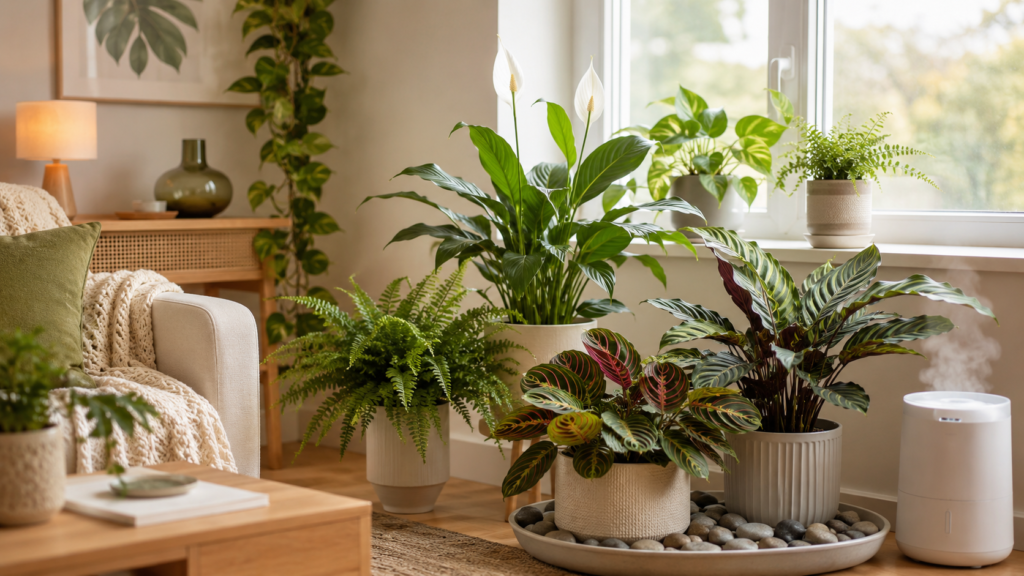
Many indoor plants struggle when the air inside the home becomes too dry.
This often happens in winter, in heated rooms, in apartments with air conditioning, or in homes where the air feels comfortable for people but too dry for tropical plants. You may notice crispy leaf edges, curled leaves, fern tips drying fast, or new leaves that do not open smoothly.
But raising humidity does not mean turning your home into a damp room.
The goal is not wet windows, heavy air, or moisture on walls. The goal is gentle, controlled humidity around plants that actually benefit from it, while keeping the room bright, breathable, and comfortable.
A good humidity setup should help the plant without creating problems for the home.
Quick Answer
To raise humidity for indoor plants without making your home damp, focus on small, controlled methods near the plants. Group humidity-loving plants together, use a small humidifier nearby, place individual plants on pebble trays, and choose naturally humid rooms only if they also have enough light.
Avoid making the whole room feel wet. Watch for condensation on windows, musty smells, wet walls, or soil that stays damp too long. Good humidity should feel fresh and comfortable, not heavy or swampy.
Why Indoor Plants Struggle With Dry Air
Many popular houseplants come from environments where the air is naturally more humid than the average indoor room.
Plants such as Calathea, Prayer Plant, Ferns, Anthurium, Peace Lily, Fittonia, and some Begonias often appreciate extra moisture in the air. When indoor air becomes too dry, these plants may show stress even if the soil is watered correctly.
Dry air can affect the leaves before it affects the roots.
Common signs include:
- crispy brown leaf edges;
- dry fern tips;
- curled or folded leaves;
- new leaves opening poorly;
- thin leaves looking tired quickly;
- plants needing water more often than expected;
- leaf edges browning even when the soil is not completely dry.
This does not always mean the plant needs more water in the pot. Sometimes the soil is fine, but the air around the leaves is too dry.
Humidity Is Not the Same as Overwatering
A common mistake is confusing dry air with dry soil.
If a plant has crispy leaf edges, the first reaction is often to water more. But if the soil is still moist, adding more water can make the problem worse.
Humidity is moisture in the air. Watering is moisture in the soil.
A plant can have:
- dry air and wet soil;
- dry air and dry soil;
- comfortable air and wet soil;
- comfortable air and correctly watered soil.
Before changing your watering routine, check both the soil and the room conditions.
If the leaf edges are dry but the soil stays wet, the solution is not more watering. The plant may need better humidity, better airflow, improved light, or a more balanced care routine.
For more help checking soil before watering, read Don’t Water Yet: How to Check Indoor Plants Before Watering.
What Humidity-Loving Plants Actually Need
Humidity-loving plants do not need a wet room.
They usually need steadier air moisture around their leaves, especially when the home is very dry. That can be done in a controlled way without making the whole room uncomfortable.
The best setup is:
- gentle humidity near the plants;
- bright enough light;
- good airflow;
- no water collecting on surfaces;
- no condensation on windows;
- no musty smell;
- no constantly wet soil.
Humidity helps most when the rest of the care is also suitable. A Calathea in a dark corner will not thrive just because the air is humid. A Fern sitting in soggy soil will not improve simply because a humidifier is nearby.
Humidity supports care. It does not replace light, drainage, or correct watering.
Best Ways to Raise Humidity for Indoor Plants
There are several ways to increase humidity around plants, but some are more useful than others.
The best method depends on your room, plant type, light, and how many humidity-loving plants you own.
1. Use a Small Humidifier Near the Plants
A small humidifier is often the most effective option for a group of tropical houseplants.
It can provide gentle, steady moisture in the air without soaking the leaves or surface around the plant. This is especially useful during winter, in heated rooms, or in homes where the air feels dry most of the day.
Place the humidifier near the plants, but not directly against leaves, walls, curtains, books, electronics, or wooden furniture.
A good placement is usually:
- near a group of plants;
- on a stable surface;
- a little away from the wall;
- not blowing directly onto one leaf;
- not close enough to make surfaces wet.
Use a small unit for a small plant area. A huge humidifier in a tiny room can make the space too damp.
2. Group Humidity-Loving Plants Together
Grouping plants can create a slightly more humid microclimate.
As plants release moisture through their leaves, a group can hold a little more moisture around the foliage than one isolated plant. This does not turn a dry room into a rainforest, but it can help delicate plants feel less exposed.
This works best when you group plants with similar needs.
Good plants to group together include:
- Prayer Plant;
- Calathea;
- Ferns;
- Fittonia;
- Anthurium;
- Peace Lily;
- Rex Begonia;
- Nerve Plant.
Avoid grouping plants only for humidity if their light and watering needs are very different. A succulent and a fern should not be treated like they want the same environment.
3. Use a Pebble Tray Under Individual Pots
A pebble tray can help around a single plant or a small group.
To make one, place pebbles in a shallow tray, add water below the top of the pebbles, and place the plant pot on top. The pot should sit above the water, not inside it.
As the water slowly evaporates, it can add a small amount of moisture around the plant.
The important rule is simple:
The pot should not sit directly in water.
If the pot sits in water, the soil may absorb too much moisture through the drainage holes. That can lead to soggy soil and root problems.
A pebble tray is not as strong as a humidifier, but it can be useful for small plants, desks, windowsills, shelves, and individual humidity-loving plants.
4. Use Naturally Humid Rooms Carefully
Bathrooms and kitchens often have more natural humidity than bedrooms or living rooms.
But humidity alone is not enough.
A bathroom can be a good place for some plants only if it has enough natural light. A dark bathroom is not better for a plant just because the air is humid. Light still matters.
Good bathroom or kitchen candidates may include:
- Pothos;
- Ferns;
- Peace Lily;
- Prayer Plant;
- Calathea;
- Philodendron;
- Anthurium.
If the room is bright, ventilated, and not constantly wet, it can work well. If it is dark, cold, or poorly ventilated, choose another spot.
You can also read Best Plants for a Bathroom With a Window if you want specific bathroom plant ideas.
5. Keep Plants Away From Dry Air Sources
Sometimes the best humidity improvement is not adding moisture, but avoiding the driest spots.
Try not to place sensitive plants directly beside:
- heating vents;
- radiators;
- fireplaces;
- strong air conditioners;
- fans blowing constantly;
- drafty winter windows;
- very hot sunny glass.
These spots can dry leaves quickly, even if the room itself is not extremely dry.
Move thin-leaved plants a little farther from dry air sources and group them where the air is calmer but still fresh.
What Does Not Help as Much as People Think?
Some humidity tips are popular, but their effect can be limited.
Occasional Misting
Misting can make leaves look fresh for a short time, but it does not usually raise humidity for long.
The water evaporates quickly. In some rooms, the effect may last only briefly. Misting can also leave spots on leaves or furniture if done too often.
Misting is not useless, but it should not be the main humidity plan for plants that truly struggle in dry air.
If you mist, do it lightly, avoid soaking the leaves, and make sure the plant has airflow.
One Tiny Tray for a Large Plant Collection
A small pebble tray under one pot will not raise humidity for an entire room or a large plant collection.
It may help the plant sitting on it, but the effect is local.
For a larger group of humidity-loving plants, a small humidifier or better grouping is usually more effective.
Putting Plants in a Dark Room Just for Humidity
This is a common mistake.
A plant may like humidity, but it still needs light. A dark bathroom, dark kitchen corner, or windowless room is usually not a good long-term solution.
If the plant cannot get enough light, humidity will not solve the main problem.
Making the Room Feel Wet
More humidity is not always better.
If the room starts to feel heavy, damp, or musty, the setup has gone too far. Indoor plant care should not create a home environment that feels uncomfortable or unhealthy.
Humidity should support plants while keeping the room pleasant for people.
Signs the Air Is Too Dry
Dry air can show up in several ways.
Your plants may need more humidity support if you notice:
- crispy brown leaf edges;
- dry tips on ferns;
- Calathea or Prayer Plant leaves curling often;
- new leaves opening poorly;
- leaves looking thin or papery;
- repeated browning even when watering is correct;
- plants struggling more during winter heating season;
- leaf edges drying faster near vents or radiators.
Before assuming humidity is the only problem, also check light, watering, pot size, drainage, and soil condition.
Dry air often works together with other stress factors.
Signs the Room Is Too Damp
A humidity setup can also go too far.
The room may be too damp if you notice:
- condensation on windows;
- water droplets on walls or nearby surfaces;
- a musty smell;
- mold near windows, walls, or soil surfaces;
- soil staying wet longer than normal;
- leaves staying wet for long periods;
- the room feeling heavy or uncomfortable.
If this happens, reduce humidifier use, improve airflow, move the humidifier farther from surfaces, and check whether the room is getting enough ventilation.
The goal is not a wet room. The goal is comfortable air.
The Balanced Goal
Healthy humidity should feel fresh, not swampy.
A good indoor plant humidity setup has:
- comfortable air for people and plants;
- steady gentle humidity;
- bright enough light;
- good ventilation;
- no wet surfaces;
- no condensation;
- no musty smell;
- no constantly wet soil.
If your setup creates damp windows or heavy air, adjust it.
Best Plants for Higher Humidity
Some plants usually benefit more from added humidity than others.
Calathea
Calathea is known for patterned leaves and a higher sensitivity to dry indoor air.
If the air is too dry, leaf edges may brown or curl. Calathea usually does best with steady moisture, bright indirect light, and gentle humidity.
Prayer Plant
Prayer Plant often appreciates extra humidity, especially in dry homes.
It can be a good candidate for grouping with other humidity-loving plants. It also looks beautiful in a plant corner with soft light and consistent care.
See the full guide here: Prayer Plant Care: How to Grow Maranta Indoors.
Ferns
Many ferns dislike very dry air.
Fern tips may dry quickly when the room is too dry. A bright bathroom, grouped plant area, pebble tray, or small humidifier can help, depending on the room.
Anthurium
Anthurium often appreciates extra humidity, especially when growing indoors in dry air.
It still needs bright indirect light and careful watering. Humidity helps, but it does not replace proper drainage or light.
Read more here: Anthurium: The Glossy Indoor Flower That Feels Tropical and Elegant.
Peace Lily
Peace Lily can tolerate average indoor conditions, but it often looks better with more consistent humidity.
It can work well in a grouped plant area or bright bathroom with enough light.
Read more here: Peace Lily: The Elegant White Indoor Flower for Calm Rooms.
Fittonia
Fittonia, also called Nerve Plant, often prefers more moisture in the air than many typical houseplants.
It can be a good candidate for a terrarium-style setup, a grouped plant area, or a carefully managed humid spot.
Read more here: Nerve Plant: The Tiny Patterned Plant That Loves Humidity.
Plants That Usually Do Not Need Extra Humidity
Not every plant needs a humidifier.
Some common houseplants usually do fine in average home humidity, as long as they have the right light and watering routine.
These may include:
- Snake Plant;
- ZZ Plant;
- Pothos;
- Heartleaf Philodendron;
- Cast Iron Plant;
- many succulents;
- many cacti.
These plants may tolerate extra humidity, but they usually do not need a special humidity setup unless the home is extremely dry.
This is why it is important to match humidity to the plant type, not treat every plant the same way.
Should You Buy a Humidifier for Indoor Plants?
A humidifier can be useful if you own several humidity-loving plants and your home is consistently dry.
It may be worth considering if:
- brown leaf edges keep returning;
- the air feels very dry from heating or AC;
- you own several Calatheas, Ferns, Prayer Plants, Fittonias, Anthuriums, or Peace Lilies;
- pebble trays are not enough;
- sensitive plants are grouped in one bright area;
- you can monitor the room and avoid condensation.
A humidifier may not be necessary if:
- your plants are mostly Snake Plants, ZZ Plants, Pothos, succulents, or cacti;
- your home already has comfortable humidity;
- the room has poor airflow;
- windows already collect condensation;
- you do not want to maintain or clean the humidifier;
- your plant problems are caused by overwatering, poor light, or wrong pot size instead.
A humidifier is helpful only when it solves the actual problem.
Where to Place a Humidifier for Plants
Place a humidifier close enough to help the plants, but not so close that leaves, walls, or furniture stay wet.
Good placement tips:
- keep it near the plant group;
- place it on a stable surface;
- keep it away from walls and curtains;
- do not point mist directly at one plant;
- avoid placing it over books or electronics;
- avoid wetting wooden furniture;
- keep the area bright and ventilated;
- check nearby windows for condensation.
If leaves stay wet for a long time, move the humidifier farther away or reduce the setting.
How Long Should You Run a Humidifier?
There is no perfect time for every home.
A small humidifier may be used for a short period during the driest part of the day, or longer on a low setting if the room stays comfortable and dry.
Start small.
Run it for a limited time, observe the plants, and check the room. Watch for leaf response, window condensation, damp surfaces, and soil drying speed.
If the room starts to feel damp, reduce use.
If plants still show dry-air stress and the room stays comfortable, you may increase the time slightly.
How to Raise Humidity Without a Humidifier
You can still help plants without a humidifier.
Try:
- grouping humidity-loving plants together;
- using pebble trays under individual plants;
- moving sensitive plants away from vents or radiators;
- choosing a brighter naturally humid room;
- keeping plants away from hot dry windows;
- using a glass cabinet or terrarium-style setup for small humidity-loving plants;
- keeping watering consistent but not excessive.
These methods may not be as powerful as a humidifier, but they can still help when used correctly.
Do Pebble Trays Really Work?
Pebble trays can help a little, but they are not magic.
They are best for small plants or individual pots. They will not raise humidity across a full room in a dramatic way.
To use one safely:
- Choose a shallow tray.
- Add clean pebbles.
- Add water below the top of the pebbles.
- Place the pot on the pebbles, not in the water.
- Refill as the water evaporates.
- Clean the tray regularly.
The pot should never sit directly in standing water.
Should You Mist Indoor Plants?
Misting is not the same as raising humidity.
It may offer a brief moisture boost on the leaf surface, but it usually does not change the air for long. It can also become a problem if leaves stay wet in a room with poor airflow.
Misting may be acceptable for some plants if done lightly, but it should not be your only strategy for humidity-loving plants.
If you mist, do it in the morning, avoid soaking leaves, and make sure the plant has good airflow.
How to Avoid Mold, Condensation, and Damp Air
This is the most important part.
Indoor humidity should not damage the home.
To keep the setup safe and comfortable:
- avoid running a humidifier too close to walls;
- do not aim mist directly at windows;
- keep plants away from cold damp corners;
- check for condensation in the morning;
- keep airflow moving gently;
- avoid constantly wet soil;
- empty water collected in cover pots;
- clean pebble trays;
- clean the humidifier as recommended by the manufacturer;
- stop if the room smells musty.
If a humidity method creates dampness, reduce it or change the setup.
A Simple Humidity Plan You Can Copy
Use this plan for a plant group:
- Choose only the plants that actually benefit from humidity.
- Move them to a bright area with indirect light.
- Group them together without crowding the leaves.
- Add a pebble tray under the most sensitive plants.
- Use a small humidifier nearby if the air is still very dry.
- Keep mist away from walls, windows, and furniture.
- Watch leaves, soil, windows, and room smell.
- Adjust if the room feels damp.
This creates support for the plants without turning the room into a wet space.
Common Humidity Mistakes
Using a huge humidifier in a tiny room
More power is not always better.
A small room can become damp quickly if the humidifier is too strong or runs too long.
Misting once and expecting lasting results
Misting has a short effect.
It does not usually solve long-term dry air problems on its own.
Ignoring airflow
Humidity without airflow can create problems.
Plants need comfortable air, not still damp air.
Keeping plants in a dark bathroom
A bathroom may be humid, but plants still need light.
Only use a bathroom if it has enough natural brightness for the plant.
Letting water collect in cover pots
Decorative cover pots can hide standing water.
Always check that the plant is not sitting in water after watering.
Raising humidity for every plant
Not every plant needs extra humidity.
Focus on plants that actually benefit from it.
Final Thoughts
Raising humidity for indoor plants can help, but it should be done carefully.
The goal is not to make your home damp. The goal is to create a gentle, comfortable environment around the plants that truly need extra moisture in the air.
Start with the basics: good light, correct watering, suitable pot size, and healthy airflow. Then add humidity support where it actually helps.
For many homes, the best setup is simple: group humidity-loving plants in a bright spot, use a small humidifier nearby if needed, add pebble trays for individual plants, and watch for signs that the room is becoming too damp.
Healthy humidity should feel fresh.
If the room feels wet, smells musty, or shows condensation, reduce the humidity and improve airflow.
Your plants should feel supported, and your home should still feel comfortable.
Read Next
- Nerve Plant: The Tiny Patterned Plant That Loves Humidity
- Prayer Plant Care: How to Grow Maranta Indoors
- Anthurium: The Glossy Indoor Flower That Feels Tropical and Elegant
- Peace Lily: The Elegant White Indoor Flower for Calm Rooms
- Best Plants for a Bathroom With a Window

Cosmin Stefanoiu is the founder and editor of The Leafy Room, a practical guide focused on indoor plants, plant care, pots and planters, small-space gardening, and thoughtful plant styling.
He creates clear, beginner-friendly editorial guides designed to help readers choose plants, understand everyday care, and make practical decisions for real homes.
Pingback: How to Bring Outdoor Plants Indoors for Winter
Pingback: Best Plant Misters for Indoor Plants
Pingback: Best Hygrometers for Indoor Plants