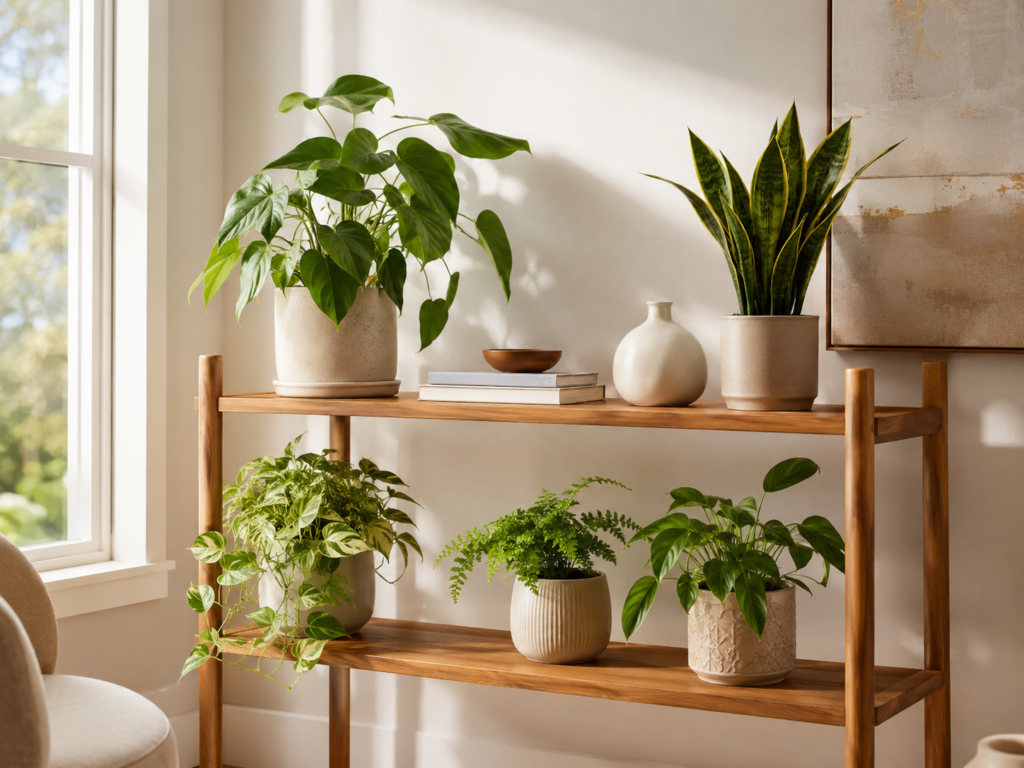
A plant shelf can make a room feel warm, cozy, and full of life.
But it can also become messy very quickly.
Too many tiny pots, random decor pieces, different pot colors, flat heights, and no empty space can turn a beautiful plant shelf into visual clutter. The plants may be healthy, but the shelf still looks busy.
The secret is not adding more plants.
The secret is editing what you already have.
A good plant shelf makeover uses fewer items, better spacing, mixed heights, repeated colors, and plants with different shapes. The result feels calmer, cleaner, and more intentional.
Quick Answer: How Do You Style a Plant Shelf Without Clutter?
To style a plant shelf without clutter, start with 3–5 favorite plants, use different heights, repeat one or two pot colors, leave empty space, and add only one or two simple decor pieces.
A balanced plant shelf usually includes:
- one taller plant
- one trailing plant
- one compact plant
- one stack of books or tray
- one simple decor object
- some empty space
The goal is to make each plant stand out instead of making every inch of the shelf full.
Plant Shelf Makeover Checklist
Before you start moving plants around, use this quick checklist.
| Shelf question | Best answer |
|---|---|
| Are there too many small pots? | Remove a few and keep the best ones |
| Is everything the same height? | Add books, risers, or a plant stand |
| Are there too many colors? | Repeat one or two pot colors |
| Is every space filled? | Leave empty space so the shelf can breathe |
| Are plants blocking each other? | Separate different shapes and sizes |
| Does the shelf feel random? | Choose one focal plant and build around it |
| Are decor objects competing with plants? | Keep only one or two simple accents |
A cleaner shelf usually feels better than a fuller shelf.
Why Plant Shelves Look Messy
A plant shelf often looks messy for one simple reason: everything is competing for attention.
This can happen when there are too many small pots, too many leaf shapes, too many pot colors, too many decor pieces, and no clear focal point.
Common reasons a plant shelf looks cluttered include:
- too many tiny pots
- no empty space
- all plants at the same height
- too many different pot colors
- random decor items
- plants blocking each other
- trailing plants hanging in every direction
- no repeated materials
- no clear visual rhythm
The shelf may be full of beautiful things, but the overall effect can still feel chaotic.
The Simple Plant Shelf Formula
A styled plant shelf does not need to be complicated.
A simple formula is:
| Shelf element | Why it helps |
|---|---|
| Tall plant | Adds height and structure |
| Trailing plant | Softens edges and creates movement |
| Compact plant | Fills a small space without clutter |
| Books or tray | Adds layers and organization |
| One decor object | Gives personality without overwhelming |
| Empty space | Makes everything look calmer |
This formula works because it mixes shapes, heights, and textures without overcrowding the shelf.
Step 1: Remove Everything First
The easiest plant shelf makeover starts by removing everything.
Take off the plants, books, baskets, candles, trays, and small objects. Wipe the shelf clean and look at the empty space.
This helps you stop decorating around clutter.
Once the shelf is empty, you can choose what deserves to go back.
Ask yourself:
- Which plants look healthiest?
- Which pots look best together?
- Which items do I actually like?
- Which pieces are just filling space?
- Which plants need more light?
- Which vines are getting too long?
- Which items make the shelf feel busy?
Do not skip this step. Editing is the most important part of the makeover.
Step 2: Choose One Focal Plant
Every plant shelf needs one main plant.
This is the plant that catches the eye first. It may be taller, fuller, brighter, or more sculptural than the others.
Good focal plants include:
- Snake Plant
- ZZ Plant
- Monstera
- Rubber Plant
- Bird of Paradise
- Peace Lily
- large Pothos
- Philodendron
- Cast Iron Plant
Place the focal plant first.
After that, every other item should support it, not compete with it.
Step 3: Add Height
Flat shelves look boring.
If every plant sits directly on the same shelf level, the display can feel stiff and crowded. Add height with books, small stands, risers, trays, or a taller pot.
Good ways to add height include:
- stack two neutral books under a plant
- use a small wooden riser
- place one plant on a mini stand
- choose one taller pot
- use a plant with upright leaves
- place a trailing plant higher than compact plants
Height helps the eye move across the shelf naturally.
It also helps plants stand out instead of blending into one flat green line.
Step 4: Use Different Plant Shapes
A good plant shelf has shape variety.
If all the plants look similar, the shelf can feel repetitive. Mixing plant shapes creates balance.
Useful plant shapes include:
| Plant shape | Example | What it adds |
|---|---|---|
| Upright | Snake Plant, ZZ Plant | Structure and height |
| Trailing | Pothos, Hoya, Philodendron | Movement and softness |
| Compact | Peperomia, Pilea, Fittonia | Small-scale detail |
| Broad leaf | Monstera, Peace Lily | Fullness and softness |
| Fine texture | Ferns | Delicate detail |
A simple shelf may only need three shapes: upright, trailing, and compact.
Step 5: Repeat Pot Colors
Too many pot colors can make a shelf look messy even when the plants are beautiful.
Try repeating one or two pot colors.
Good combinations include:
- cream and terracotta
- white and warm beige
- sage green and cream
- natural clay and wood
- matte black and warm wood
- woven baskets and neutral ceramic
Repeating colors makes the shelf feel intentional.
It also helps the plants become the focus instead of the pots.
Step 6: Leave Empty Space
Empty space is not wasted space.
It makes the shelf feel calmer and gives each plant room to stand out.
A shelf with empty space often looks more expensive, more styled, and easier to enjoy than a shelf packed with every plant you own.
Leave space:
- beside a focal plant
- above a trailing vine
- between pot groups
- around a small decor object
- at the end of a shelf
- behind taller leaves
Negative space helps your plant shelf breathe.
Step 7: Group in Threes
Grouping items in threes is a simple styling trick.
A group of three can feel balanced without looking too perfect.
Example shelf group:
- one plant
- one book stack
- one small ceramic bowl
Another example:
- one trailing plant
- one framed botanical print
- one candle
Keep the group simple. You do not need three plants in every group. Mix plants with practical decor.
Best Plants for a Styled Shelf
Some plants work especially well on shelves because they have clear shapes or stay easy to manage.
| Plant | Why it works |
|---|---|
| Pothos | Trails beautifully and softens edges |
| ZZ Plant | Adds upright structure and glossy leaves |
| Snake Plant | Creates height and a clean vertical shape |
| Peperomia | Compact and tidy for small spaces |
| Hoya Carnosa | Trails elegantly and may bloom indoors |
| Silver Satin Pothos | Adds soft silver-patterned leaves |
| Fern | Adds fine texture and softness |
| Peace Lily | Adds glossy leaves and white blooms |
| Pilea | Adds round leaves and a playful shape |
| Philodendron | Easy trailing or climbing greenery |
Choose plants by shape, not just by popularity.
A shelf full of different shapes looks more balanced than a shelf full of similar small pots.
Best Plant Shelf Combinations
Here are simple combinations that work well.
| Shelf style | Plant combination |
|---|---|
| Clean and minimal | Snake Plant + Pothos + Peperomia |
| Cozy and full | Hoya + Fern + ZZ Plant |
| Soft and relaxed | Silver Satin Pothos + Peace Lily + small trailing Philodendron |
| Modern and simple | ZZ Plant + Pilea + one ceramic decor object |
| Warm and natural | Pothos + Rubber Plant + woven basket |
| Small apartment shelf | Pilea + Peperomia + small Pothos |
For a small shelf, choose fewer plants with stronger shapes.
For a large shelf, repeat the same pot color to keep everything cohesive.
Plant Shelf Mistakes to Avoid
Too Many Tiny Pots
Lots of tiny pots can make a shelf look busy.
Use fewer plants and choose the best-looking ones.
Everything the Same Height
A shelf with no height variation can look flat.
Use books, risers, stands, or taller plants.
No Empty Space
If every inch is filled, the shelf feels crowded.
Remove a few items and let the plants breathe.
Too Many Pot Colors
Different pot colors can compete with the plants.
Repeat one or two colors for a calmer look.
Random Decor Pieces
Decor can help, but too many small objects create visual noise.
Use only one or two simple accents.
Plants Blocking Each Other
A beautiful plant can disappear if it is hidden behind another plant.
Separate different shapes so each one can be seen.
Before and After Plant Shelf Reset
A messy plant shelf usually has:
- too many small pots
- random decor objects
- flat heights
- no focal plant
- no empty space
- too many colors
- vines hanging everywhere
A cleaner plant shelf has:
- one focal plant
- a few supporting plants
- mixed heights
- repeated pot colors
- one or two decor items
- open space
- clear layers
The difference is not always about buying new things. Often, it is about removing what does not help.
How to Style a Small Plant Shelf
Small shelves need even more editing.
Use fewer plants and avoid heavy decor.
A good small shelf setup might include:
- one compact plant
- one trailing plant
- one small book stack
- one simple pot color
- one tiny decor object
- one empty corner
Small shelves look best when they are not overcrowded.
If you want a cozy look, use texture instead of adding more items. A woven basket, ceramic pot, wood tray, or linen background can add warmth without clutter.
How to Style a Tall Plant Shelf
A tall shelf can hold more plants, but it still needs structure.
Use the top shelf for lighter-looking plants or trailing vines. Use the middle shelf for the focal plant. Use the lower shelf for heavier pots, baskets, or larger plants.
A tall shelf might look like this:
| Shelf level | What to place |
|---|---|
| Top shelf | Trailing plant, small framed art, light pot |
| Middle shelf | Focal plant, books, one decor object |
| Lower shelf | Heavier plant, basket, storage, larger pot |
This keeps the shelf balanced and prevents the top from feeling too heavy.
How to Use Books on a Plant Shelf
Books are very useful for plant styling.
They help with height, layering, and color.
Use books to:
- lift a small plant
- create a clean base
- add warm neutral color
- create a horizontal layer
- balance a taller plant
- make a shelf feel more lived-in
Choose books with covers that match the room. Beige, cream, green, brown, and muted neutral covers usually work well with plant decor.
How to Use Trays and Baskets
Trays and baskets help reduce visual clutter.
A tray can group small items so they feel intentional instead of random.
A basket can hide supplies, extra pots, or small tools.
Use trays for:
- small pots
- plant care tools
- watering accessories
- candles
- small decor objects
Use baskets for:
- extra nursery pots
- plant tools
- cloths
- small bags of soil
- plant labels
Grouping items makes the shelf look cleaner without removing everything.
How to Style Trailing Plants on Shelves
Trailing plants can make a shelf look soft and cozy, but they can also become messy.
Use only one or two trailing plants per shelf area.
Let vines fall naturally, but trim or guide them if they block other plants or decor.
Good trailing shelf plants include:
- Pothos
- Silver Satin Pothos
- Hoya Carnosa
- Philodendron
- String of Pearls
- Dischidia
If the vines are very long, place the plant higher so the trailing effect feels intentional.
For more trailing plant ideas, read Silver Satin Pothos: The Trailing Plant With Silver-Splashed Leaves and Hoya Carnosa: The Wax Plant That Trails and Blooms Indoors.
Plant Shelf Styling for Beginners
Beginners should keep plant shelves simple.
Start with:
- three plants
- one pot color
- one book stack
- one decor object
- one empty space
That is enough.
Once it looks balanced, you can slowly add more.
The beginner mistake is trying to style every plant at once. A shelf looks better when it has a clear plan.
Plant Shelf Styling for Apartments
In small apartments, plant shelves can add greenery without taking up much floor space.
Use vertical space carefully.
Good apartment shelf ideas include:
- one tall narrow shelf near a bright window
- one wall shelf with trailing plants
- one plant stand beside a desk
- one bookcase with plants and storage baskets
- one floating shelf for small plants
Choose plants that match the light in your apartment.
Do not place plants on a shelf just because it looks good in photos. They still need useful light.
Light Matters More Than Styling
A shelf can look perfect, but if it is too dark, the plants may struggle.
Before styling, check the light.
Ask:
- Is the shelf near a window?
- Does it get bright indirect light?
- Are plants blocked by the shelf above?
- Do trailing plants shade smaller plants?
- Is the shelf too far from natural light?
- Does the room stay dim all day?
If the shelf is low light, choose more forgiving plants like ZZ Plant, Snake Plant, or Cast Iron Plant.
If the shelf is bright, you have more options.
Best For / Avoid If
A plant shelf makeover is useful if your shelf feels messy, crowded, or unfinished.
| Best for | Avoid if |
|---|---|
| Shelves with too many plants | You do not want to remove anything |
| Small apartments | The shelf gets no natural light |
| Cozy plant decor | You want every plant on one shelf |
| Beginner plant owners | You ignore plant light needs |
| Plant corners that feel cluttered | You keep adding more tiny pots |
| Rooms that need a calmer look | You use too many pot colors |
The best shelf is not the fullest shelf. It is the shelf that makes your plants look better.
Helpful Product Ideas
For a cleaner plant shelf setup, useful items may include:
- small plant stand
- wooden riser
- neutral ceramic pots
- plant saucers
- wall shelf
- plant shelf
- decorative tray
- woven basket
- plant clips
- pruning scissors
- trailing plant hanger
- botanical art print
- simple bookends
- watering can
These items can help with height, spacing, drainage, organization, and styling.
Simple Plant Shelf Makeover Plan
Use this simple plan when your shelf feels messy.
Step 1
Remove everything from the shelf.
Step 2
Choose one focal plant.
Step 3
Add one trailing plant.
Step 4
Add one compact plant.
Step 5
Use books or a riser to create height.
Step 6
Add one simple decor object.
Step 7
Leave one empty area.
Step 8
Step back and remove anything that feels extra.
This quick reset can make a plant shelf feel more styled in minutes.
Final Thoughts
A plant shelf makeover does not require more plants.
It usually requires fewer items, better spacing, and a clearer plan.
Choose one focal plant, add height, mix plant shapes, repeat pot colors, use only a few decor pieces, and leave empty space. These small changes can make your shelf feel calmer, cleaner, and more intentional.
Plants are already beautiful.
The right shelf setup simply gives them room to stand out.
Read Next
- Best Indoor Plant Tools for Beginners
- Best Pots for Indoor Plants
- Silver Satin Pothos: The Trailing Plant With Silver-Splashed Leaves
- Hoya Carnosa: The Wax Plant That Trails and Blooms Indoors
- Best Indoor Plants for a Home Office Desk

Cosmin Stefanoiu is the founder and editor of The Leafy Room, a practical guide focused on indoor plants, plant care, pots and planters, small-space gardening, and thoughtful plant styling.
He creates clear, beginner-friendly editorial guides designed to help readers choose plants, understand everyday care, and make practical decisions for real homes.