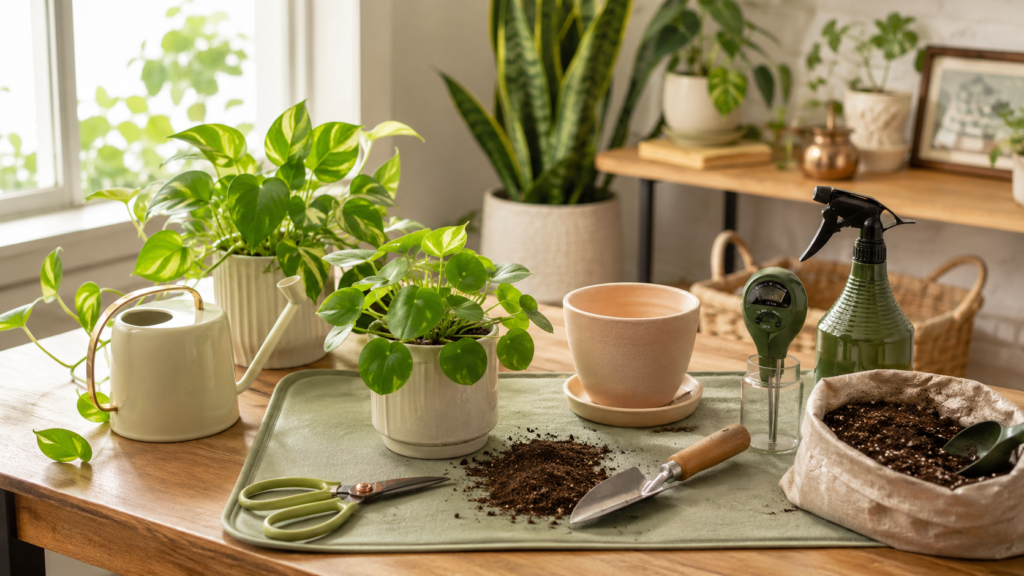
Most beginners think they need a full shelf of plant tools.
They do not.
Indoor plant care becomes easier when you have a few useful basics, not when you buy every tool you see online. A simple watering can, pots with drainage, plant saucers, light potting mix, pruning scissors, and a small repotting setup can make plant care cleaner, calmer, and much less confusing.
The best indoor plant tools for beginners are the ones that solve real problems: messy watering, soggy roots, dirty tables, overgrown leaves, and stressful repotting.
If you are new to houseplants, start simple.
Quick Answer: What Indoor Plant Tools Do Beginners Actually Need?
Beginners do not need many plant tools.
The most useful indoor plant tools for beginners are:
- a narrow-spout watering can
- plant saucers
- pots with drainage holes
- light indoor potting mix
- pruning scissors
- a small trowel or soil scoop
- a repotting mat
- a soft cloth for leaves
- plant labels
- a spray bottle only if your plants actually need it
You can add extra tools later, but you do not need to buy everything at once.
Quick Decision Table
If you are just starting with indoor plants, use this simple guide.
| If you need help with… | Get this first |
|---|---|
| Watering neatly | Narrow-spout watering can |
| Avoiding water damage | Plant saucers |
| Preventing soggy roots | Pots with drainage holes |
| Repotting without mess | Repotting mat |
| Trimming dead leaves | Pruning scissors |
| Moving soil into pots | Small trowel or soil scoop |
| Keeping leaves clean | Soft cloth |
| Remembering plant names | Plant labels |
| Checking moisture | Moisture meter, optional |
| Raising plants off surfaces | Plant stand, optional |
The goal is not to own the most tools. The goal is to make plant care easier.
Why Beginners Should Not Buy Every Plant Tool
Plant tools can be helpful, but too many tools can make indoor plant care feel more complicated than it needs to be.
Many beginners buy products before they understand what their plants actually need. This can lead to clutter, wasted money, and confusion.
Before buying a tool, ask:
- Does this solve a real problem?
- Will I use it every week?
- Does it help with watering, drainage, cleaning, or repotting?
- Is it useful for the plants I already own?
- Am I buying it because I need it or because it looks aesthetic?
A few good tools are better than a drawer full of products you never use.
Must-Have Indoor Plant Tools for Beginners
These are the tools I would start with first.
1. Narrow-Spout Watering Can
A narrow-spout watering can helps you water the soil more accurately.
This is useful indoors because you do not want water splashing across shelves, tables, windowsills, or floors.
A good indoor watering can should be:
- easy to hold
- not too large
- comfortable to pour
- narrow enough to reach the soil
- attractive enough to keep nearby
A narrow spout helps you water the base of the plant instead of soaking leaves, books, furniture, or decor.
2. Plant Saucers
Plant saucers are simple, but they are very important indoors.
They help protect:
- wooden shelves
- desks
- windowsills
- plant stands
- floors
- side tables
- bedroom dressers
A saucer catches extra water after watering. Just remember to empty standing water so the plant does not sit in it for too long.
Plant saucers are especially useful if you keep plants on furniture.
3. Pots With Drainage Holes
A pretty pot is not enough.
For most indoor plants, drainage matters more than decoration. A pot with drainage holes allows extra water to escape, which makes watering safer and easier.
Beginner-friendly pot setups include:
- nursery pot inside a decorative cachepot
- ceramic pot with drainage and saucer
- plastic pot with drainage inside a basket cover
- terracotta pot with drainage for plants that like faster drying soil
If you need help choosing containers, read Best Pots for Indoor Plants.
4. Light Indoor Potting Mix
Good soil makes plant care easier.
Many indoor plants do better in a light, well-draining potting mix instead of heavy soil that stays wet for too long.
A useful beginner setup may include:
- indoor potting mix
- perlite for drainage
- orchid bark for extra airflow
- succulent mix for plants that prefer drier conditions
You do not need every soil product immediately. Start with a quality indoor potting mix and add extras when your plant collection becomes more varied.
5. Pruning Scissors
Pruning scissors help you remove:
- dead leaves
- yellow leaves
- damaged stems
- leggy growth
- old flower stems
- messy trailing vines
Clean scissors make the plant look better and help you avoid tearing leaves by hand.
Keep your pruning scissors clean and use them only for plant care if possible.
6. Repotting Mat
A repotting mat is one of the most useful tools if you care for plants indoors.
It helps keep soil from spreading across the table, floor, or countertop.
A repotting mat is useful for:
- repotting plants
- adding fresh soil
- separating pups
- checking roots
- mixing soil
- cleaning up faster
If you do not want to buy one right away, you can start with an old tray, newspaper, or washable table covering. But a foldable repotting mat makes the job cleaner.
7. Small Trowel or Soil Scoop
A small trowel or soil scoop helps you move soil into pots without making a big mess.
This is especially helpful when working with small pots, shelves, or apartment spaces.
You do not need a large garden shovel for indoor plants. A compact scoop is usually enough.
8. Soft Leaf Cloth
A soft cloth is simple but useful.
Dust can collect on indoor plant leaves, especially in living rooms, bedrooms, and offices. A soft cloth helps keep leaves clean and glossy.
This is useful for plants like:
- Rubber Plant
- Peace Lily
- Cast Iron Plant
- Bird of Paradise
- Pothos
- Philodendron
- Hoya Carnosa
For glossy plants like Rubber Plant or Peace Lily, clean leaves can make the plant look much better.
9. Plant Labels
Plant labels are optional, but they can be helpful if you have several plants.
They help you remember:
- plant names
- repotting dates
- propagation dates
- care notes
- which cutting came from which plant
This is especially useful if you are growing plant cuttings, pups, or multiple small pots.
10. Moisture Meter
A moisture meter is not required, but some beginners like having one.
It can help you check moisture deeper in the pot, especially for larger plants or people who tend to overwater.
However, do not rely on it completely.
Use it together with:
- finger test
- pot weight
- soil appearance
- plant condition
- room light
If watering is your biggest struggle, also read Don’t Water Yet: How to Check Indoor Plants Before Watering.
Must-Have vs Nice-to-Have Tools
Beginners should start with basics before buying extra products.
| Tool | Must-have or nice-to-have? | Why |
|---|---|---|
| Watering can | Must-have | Makes watering cleaner and easier |
| Plant saucer | Must-have | Protects furniture and catches extra water |
| Drainage pot | Must-have | Helps prevent soggy roots |
| Indoor potting mix | Must-have | Supports healthy roots |
| Pruning scissors | Must-have | Keeps plants tidy |
| Repotting mat | Nice-to-have | Makes repotting cleaner |
| Moisture meter | Nice-to-have | Can help people who overwater |
| Plant mister | Nice-to-have | Useful only for specific needs |
| Humidifier | Nice-to-have | Not necessary for every plant |
| Plant stand | Nice-to-have | Helps with styling and light placement |
| Grow light | Nice-to-have | Useful if your home lacks enough light |
Start with the must-haves. Add nice-to-have tools later when you know what your plants actually need.
Plant Tools Beginners Do Not Need Yet
Not every plant product is essential at the beginning.
You can usually wait before buying:
- large humidifier
- expensive grow light setup
- dozens of decorative pots
- multiple plant stands
- advanced fertilizer collection
- propagation stations
- specialty soil for every plant
- large tool organizer
- fancy plant cabinet
- expensive leaf shine products
These items can be useful later, but they are not the first things a beginner needs.
Start with practical tools first.
Best Plant Tools on a Budget
If you want to keep costs low, focus on tools that prevent problems.
| Budget priority | Why it matters |
|---|---|
| Pot with drainage | Helps reduce watering mistakes |
| Saucer | Protects furniture |
| Watering can | Makes watering easier |
| Indoor potting mix | Helps root health |
| Pruning scissors | Keeps plants clean and tidy |
| Repotting mat or tray | Reduces mess |
| Soft cloth | Keeps leaves looking better |
You do not need expensive versions of every item. Simple, functional tools are enough.
The best beginner plant tool kit is practical, affordable, and easy to use.
Best Tools for Watering Indoor Plants
Watering is where many beginners struggle, so these tools are useful.
| Tool | How it helps |
|---|---|
| Narrow-spout watering can | Helps water soil without splashing |
| Plant saucer | Catches extra water |
| Moisture meter | Helps check deeper moisture |
| Pot with drainage | Lets extra water escape |
| Small towel | Cleans spills quickly |
| Plant tray | Protects surfaces |
A good watering setup should make it easy to water the soil, protect surfaces, and avoid leaving plants sitting in water.
For more watering help, see Don’t Water Yet: How to Check Indoor Plants Before Watering.
Best Tools for Repotting Indoor Plants
Repotting is much easier when everything is ready before you start.
Useful repotting tools include:
- repotting mat
- fresh potting mix
- small trowel
- pot with drainage
- plant saucer
- pruning scissors
- gloves, optional
- small brush or cloth
- trash bag or compost container
Set up your repotting area first. This makes the job faster and cleaner.
Simple Beginner Plant Tool Kit
Here is a simple beginner kit that works for most indoor plant owners.
| Tool | Use |
|---|---|
| Narrow-spout watering can | Watering plants neatly |
| Plant saucers | Protecting furniture |
| Pots with drainage | Preventing standing water |
| Indoor potting mix | Repotting and refreshing soil |
| Pruning scissors | Removing damaged leaves |
| Repotting mat | Keeping surfaces clean |
| Small trowel | Moving soil into pots |
| Soft cloth | Cleaning leaves |
| Plant labels | Tracking plants and cuttings |
This is enough for most beginners.
You can add more tools later when your plant collection grows.
Tool Setup for a Small Apartment
If you live in a small apartment, you do not need bulky plant supplies.
Choose compact items:
- small watering can
- foldable repotting mat
- one bag of indoor potting mix
- small pruning scissors
- stackable saucers
- small soil scoop
- one storage basket
- a soft cloth
Keep everything together in one basket, drawer, or shelf bin.
A small plant tool setup should be easy to store and easy to use.
Common Mistakes When Buying Plant Tools
Buying Too Much Too Soon
Many beginners buy tools before they know what they need.
Start with the basics and add slowly.
Choosing Pretty Tools That Do Not Work Well
A watering can can look beautiful but still spill everywhere.
Choose useful first, pretty second.
Forgetting Drainage
Decorative pots are nice, but plants need a drainage plan.
Drainage holes, nursery pots, saucers, and cachepots matter.
Buying Tools for Plants You Do Not Own
You do not need orchid tools if you do not have orchids.
You do not need cactus soil if you do not have cacti or succulents.
Buy for your real plant collection.
Not Having a Repotting Surface
Repotting directly on a table or floor can get messy fast.
Use a mat, tray, or washable surface.
Relying Too Much on a Moisture Meter
A moisture meter can help, but it should not replace observation.
Check the plant, the soil, the pot, and the room conditions too.
Best For / Avoid If
A beginner plant tool kit is useful, but it should stay simple.
| Best for | Avoid if |
|---|---|
| New plant owners | You want to buy every tool at once |
| Small indoor plant collections | You only want decorative products |
| Apartment plant care | You have no storage space for extras |
| Cleaner watering and repotting | You ignore drainage completely |
| People who overwater | You rely only on a moisture meter |
| Budget-friendly plant care | You buy tools before knowing your plants |
The right tools should make plant care easier, not more stressful.
Helpful Product Types to Consider
When building a beginner plant care kit, useful product types may include:
- narrow-spout watering can
- plant saucers
- pots with drainage holes
- decorative cachepots
- indoor potting mix
- perlite
- orchid bark
- pruning scissors
- repotting mat
- small trowel
- soil scoop
- soft leaf cloth
- plant labels
- moisture meter
- storage basket
Choose products that solve real beginner problems: watering, drainage, cleaning, repotting, and organization.
Which Tool Should You Buy First?
If you only buy one thing, start with a good watering can or pots with drainage.
If your biggest issue is mess, buy a repotting mat.
If your biggest issue is overwatering, focus on drainage pots, saucers, and better watering habits.
If your plants look messy, buy pruning scissors and a soft cloth.
If your shelves get water marks, buy saucers and trays.
The best first tool depends on the problem you actually have.
Final Thoughts
You do not need every plant tool to take good care of indoor plants.
Most beginners only need a few practical basics: a watering can, plant saucers, pots with drainage, light potting mix, pruning scissors, and a clean place to repot.
Start small. Buy tools that solve real problems. Skip expensive extras until you know your plants, your space, and your habits.
The right tools make plant care simpler, cleaner, and more enjoyable.
Good tools do not replace attention, but they can help you build better plant care habits from the beginning.
Read Next
- Best Pots for Indoor Plants
- Don’t Water Yet: How to Check Indoor Plants Before Watering
- Best Indoor Plants for a Home Office Desk
- Rubber Plant: The Indoor Tree That Makes Any Room Look Better
- Silver Satin Pothos: The Trailing Plant With Silver-Splashed Leaves

Cosmin Stefanoiu is the founder and editor of The Leafy Room, a practical guide focused on indoor plants, plant care, pots and planters, small-space gardening, and thoughtful plant styling.
He creates clear, beginner-friendly editorial guides designed to help readers choose plants, understand everyday care, and make practical decisions for real homes.
Pingback: Plant Shelf Makeover: How to Style Indoor Plants Without Clutter